UK Landlord Repair Responsibilities: A Practical Guide

What if the hardest part of a repair isn’t the fault itself, but knowing who must act and how quickly? For landlords, uncertainty can mean delays, safety concerns and avoidable disputes. Understanding landlord responsibilities for repairs UK renters and property owners need to know starts with recognising that some duties are set by law and can’t be shifted to a tenant through a tenancy agreement.
It’s understandable to feel unsure when a tenant reports a leak, heating failure or damp. Not every job has the same urgency, and repair rules differ across England, Wales, Scotland and Northern Ireland. In England’s private rented sector, landlords must deal with covered repairs within a reasonable time after being notified.
This guide explains which repairs generally fall to the landlord, where a tenant’s responsibilities begin and how to respond to a report. You’ll learn how to record the issue, assess urgency, arrange access and keep communication clear. A consistent process helps protect tenants and the property, whether you manage a home yourself or use professional maintenance support across Liverpool, St Helens, Wigan, Manchester, Salford or Warrington.
Table of Contents
Landlord responsibilities for repairs in the UK: what the rules cover
Repair responsibilities are a landlord’s legal obligations to keep specified parts of a rented home and its essential installations in repair. Acting promptly matters: a small fault can worsen, disrupt a tenant’s use of the home or create a health and safety risk. The rules depend on where the property is, so the legal detail here focuses on England.
Which UK jurisdiction applies to the tenancy?
Housing law differs across England, Wales, Scotland and Northern Ireland. The rules depend on where the property is located, not where the landlord lives or where the tenancy was arranged. This guide concentrates on England, including homes in Liverpool, St Helens, Wigan, Manchester, Salford and Warrington. Landlords with properties elsewhere in the UK need to follow the rules that apply in that nation.
What counts as a repair responsibility?
For many private rented homes in England, a central starting point is section 11 of the Landlord and Tenant Act 1985. It requires landlords to keep the structure and exterior in repair, along with installations for water, gas, electricity, sanitation, space heating and hot water. A fault with a roof or fixed heating installation may therefore need a different response from a tenant’s request to redecorate.
In England, a landlord’s repair responsibility is the legal duty to keep the property’s structure, exterior and specified essential installations in repair, and to address covered faults within a reasonable time after being notified. There is no single response deadline for every private-sector repair. The fault, its impact and the circumstances all matter.
A repair obligation is distinct from other safety responsibilities. A landlord may need to address a physical defect and consider whether it creates a hazard under the HHSRS, the Housing Health and Safety Rating System local authorities use to assess risks in residential properties. Gas and electrical safety requirements are separate duties. Meeting them does not replace the responsibility to repair a fault. Because disrepair and property hazards can also introduce broader liability risks, many landlords consult WS Insurance Brokers to ensure appropriate indemnity coverage is in place.
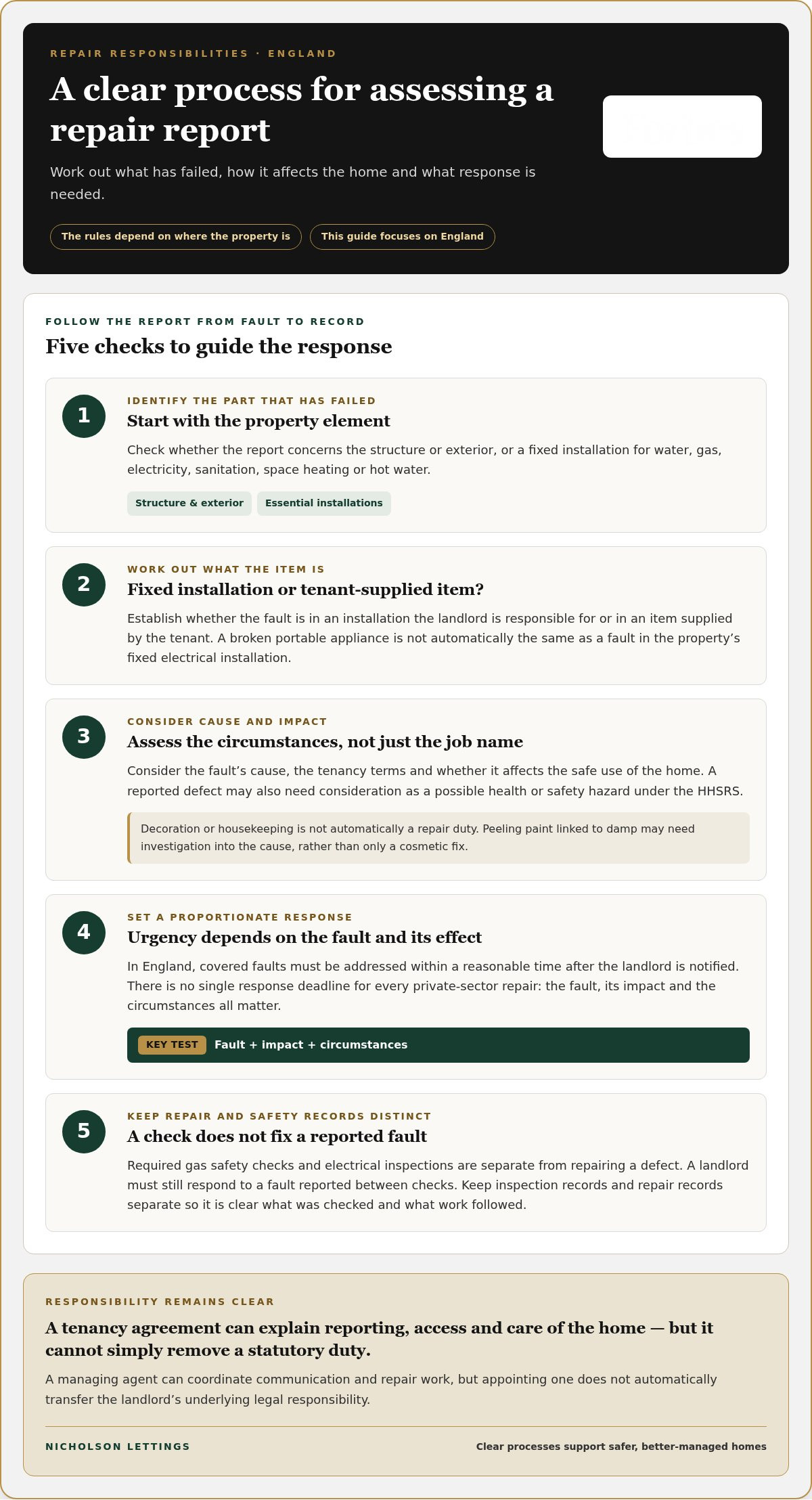
The tenancy agreement can explain how tenants should report problems, arrange access and look after the home. It cannot simply remove a statutory duty. A statutory duty is a legal obligation imposed by legislation on an individual or authority. Appointing a managing agent to coordinate repairs can help organise communication and work, but it does not automatically transfer the landlord’s underlying legal responsibility.
Read the agreement alongside the law, then assess each report on its facts. This gives landlords and tenants a clearer basis for deciding what needs attention and who should arrange it.
Which repairs must a landlord arrange in an English rental property?
Start with the part of the home that has failed, rather than just the name of the job. A dripping tap, a roof leak and a faulty fixed heating system raise different questions about the landlord’s repair duty, urgency and any separate safety requirement. The tenancy terms and the cause of the fault also matter.
For a typical private tenancy in England, the main repair categories are the property’s structure and exterior, plus fixed installations for water, gas, electricity, sanitation, space heating and hot water. This may include assessing damaged roof coverings, leaking pipework, defective wiring or a heating system that no longer works. The specific defect and the law applying to the tenancy determine what the landlord needs to do.
Structure, essential services and fixed installations
A problem with a roof, external wall, window or drain may concern the structure or exterior. A fault in a fixed water, electrical or heating installation may fall within another part of the repair duty. Establish what has failed and whether the issue affects the safe use of the home. A broken portable appliance, for example, is not automatically the same as a fault in the property’s fixed electrical installation.
Landlords should establish whether the reported fault relates to an installation they’re responsible for or to an item supplied by the tenant. The GOV.UK guidance on landlord repairs explains the main repair responsibilities and how they differ from tenant responsibilities. Assess the circumstances of the fault, as different problems may need different levels of urgency.
Repairs, safety checks and property standards
Repairing a defect and completing a safety check are related but separate tasks. Landlords must arrange required gas safety checks and electrical inspections, and they must also respond if a fault is reported between checks. An inspection record does not fix a broken installation. Keep safety records and repair records distinct so it’s clear what was checked and what work followed.
Decoration and day-to-day housekeeping aren’t automatically repair duties. Tenants are generally expected to keep the home reasonably clean and take care of it, while the tenancy agreement may explain who handles routine decorating. But don’t dismiss a decoration or maintenance report without considering the underlying condition. Peeling paint linked to damp, for instance, may need an investigation into the cause rather than a cosmetic fix.
The HHSRS, or Housing Health and Safety Rating System, is the system local authorities use to assess risks from hazards in residential properties. It helps identify whether a defect presents a health or safety risk; it isn’t a decoration checklist. The Decent Homes Standard is due to extend to private rented homes from 2035, so it should not be confused with the repair duties landlords need to meet now. Clear maintenance coordination helps keep reports and follow-up organised. Landlords can explore professional property management for support with repair management.
Who is responsible when a tenant reports damage or a fault?
A report tells you there’s a problem, but it doesn’t always show what caused it or who is responsible for putting it right. Assess the affected item, how it failed, the tenancy terms and any relevant evidence before deciding what action to take. A landlord’s repair duty doesn’t mean automatically blaming a tenant or assuming every fault has the same cause.
Use this comparison as a starting point, then assess the specific circumstances:
When the issue may be the landlord’s responsibility
A failed fixed installation, such as a heating system that stops working, may fall within the landlord’s repair duty. So might a defect in a covered part of the property. Assess what has failed and whether the legal duty applies, rather than relying only on a brief description such as “boiler problem” or “leak”. Arrange suitable work and keep the tenant informed about next steps. The law doesn’t set one completion time for every private rental repair, so assess the fault and circumstances before setting expectations.
When tenant conduct or damage may be relevant
Tenants should take reasonable care of the home and report problems promptly. However, a mark or worn surface isn’t automatically tenant-caused damage. Ordinary wear and tear is deterioration through normal use over time; whether something goes beyond that depends on the item, its condition and the evidence. A tenancy agreement can explain expectations, but it doesn’t settle disputed facts on its own.
Keep a clear record from the first report. Note when it arrived, what the tenant described, which part of the property is affected and what steps have been taken. Where available, compare this with check-in information, inspection notes or dated photographs. Ask for relevant details without implying blame. Water staining, for example, might follow a sudden leak, condensation or another cause, and the next steps depend on what an inspection finds.
A landlord’s duty to repair a covered property defect is different from deciding who is responsible for damage a tenant may have caused. Address any repair or safety concern on its merits, then assess responsibility fairly against the evidence and tenancy terms. Clear records help both parties understand what was reported, what was found and why a particular action was taken.
How should landlords handle emergency repairs and routine reports?
A clear process helps you respond consistently, whether a tenant reports an immediate danger or a minor fault for routine assessment. An emergency repair is urgent repair work required to address a serious property fault or risk. Establish what’s happening, whether anyone may be at risk and whether the property could suffer further damage, rather than relying on the label alone.
There isn’t one statutory response time for every private rental repair in England. The urgency and appropriate action depend on the facts. Use these steps to make decisions, keep tenants informed and create a useful record.
Triage the report and prioritise the response
Receive and acknowledge the report. Record when it arrived, the tenant’s description, the affected area and any photographs or other details. If information is missing, ask focused questions, such as whether water is still entering or a service has stopped working.
Assess the risk. Consider possible danger to people, the extent of damage and whether the fault is getting worse. Exposed wiring or a major leak needs prompt assessment; a loose cupboard handle is unlikely to present the same level of risk. Review the priority if the situation changes.
Decide what action is appropriate. Arrange an inspection or repair based on the symptoms and likely cause. For a routine fault, record why it has been prioritised that way and explain the next step. Don’t promise a completion date until arrangements have been made.
Agree access and keep the tenant updated. Explain who will attend and the proposed arrangements. Give the tenant a clear way to report changes, and update them if an appointment or plan changes.
Keep tenants informed and document the repair
Good communication reduces uncertainty. Confirm that you’ve received the report, summarise your understanding of the problem and explain what will happen next. If you’re still assessing the fault, say so plainly and explain when you’ll provide another update, without promising a time you can’t meet.
Keep the record together from the first report to completion. Include the report date, description, evidence, risk assessment, decisions, appointment details, access arrangements and messages exchanged. After the work, record what was done and whether follow-up is needed. If the problem persists, reopen the issue rather than treating the first visit as a resolution.
Clear repair records show what was reported, how the response was prioritised and what action followed, helping landlords maintain a consistent management process. Review the completed work where appropriate and arrange any further checks or repairs needed to address the original problem. A final update closes the loop and gives the tenant a chance to flag anything still unresolved.
Landlords who want dedicated support coordinating maintenance reports and updates can explore Nicholson Lettings’ property management support.
How professional property management supports repair responsibilities
Coordinating repairs takes time and a clear process, especially when reports need assessment, access arrangements and follow-up. Professional property management can organise those steps and keep tenants informed, but it doesn’t remove a landlord’s underlying legal responsibilities. Landlords remain accountable for the duties that apply to their property, even when an agent manages day-to-day repairs.
For landlords, a managed approach can bring reports, maintenance coordination and communication into one organised process. For tenants, knowing who is handling a report and what happens next can make a stressful fault easier to manage.
What a managed repair process can include
Nicholson Lettings operates a dedicated maintenance team alongside a specialist Tenant Liaison Officer. Together, they coordinate maintenance and support clear communication with tenants. Managed safety checks help organise property checks, while maintenance-work quality audits support review of completed work. These processes don’t prevent every fault, but they help keep attention on the repair and its follow-up.
Tenant liaison helps keep updates moving between the tenant, landlord and maintenance team. Tenants should know that a report has been received, what action is being arranged and whether further work is needed. Clear communication makes it easier to identify an unresolved issue before uncertainty grows.
A local management approach for landlords
Nicholson Lettings manages over 250 properties across the Liverpool City Region and wider North West. Its service covers Liverpool, St Helens, Wigan, Manchester, Salford and Warrington. A consistent repair process can support landlords and tenants in these areas, while the applicable housing law depends on the property’s jurisdiction.
Landlords’ repair responsibilities remain in place when repair coordination is outsourced. A property manager can organise reports and work, but landlords should understand how responsibilities are allocated, how decisions are shared and how repair records are maintained. Clear oversight helps keep the arrangement transparent for both owner and tenant.
Nicholson Lettings’ expert property management guide and Liverpool maintenance case study describe its approach to management and repair coordination. Alongside managed safety checks and maintenance-work quality audits, these resources explain how a structured service supports day-to-day property care.
If you’d like professional support to organise maintenance and keep tenant communication clear, Nicholson Lettings’ property management service brings repair coordination and tenant liaison together for landlords across the region.
Set up a clearer maintenance plan for your property
Prepare for the next repair report with a property-specific maintenance plan. It can give you and your tenants a shared reference point for how to report a fault, who handles the first response and where repair records are kept. Review the plan when the tenancy changes or you update how the property is managed. Clear arrangements make it easier to respond consistently and help everyone understand what to expect.
For landlords, understanding landlord responsibilities for repairs UK requirements is only one part of protecting and managing property assets. For investors and landlords who also oversee mixed-use or commercial portfolios alongside residential lettings, specialist brokers such as Commercial Property Insurance UK can help compare policies to safeguard premises against unexpected building risks. A reliable support structure can make it easier to keep communication clear and maintenance organised, while you remain aware of your responsibilities as the property owner.
Consider how professional support could fit your property and management needs. Nicholson Lettings’ maintenance and tenant liaison services help coordinate repairs and communication for landlords across the region.
Explore Nicholson Lettings’ property management support to organise maintenance coordination and tenant communication for your rental property.
Frequently Asked Questions
Are landlords responsible for all repairs in a rented property in the UK?
No. A landlord’s duties cover specified parts of the property and installations, but not every household task or every item a tenant brings into the home. In England, section 11 of the Landlord and Tenant Act 1985 sets out key repair duties for many private tenancies. Rules differ across the UK, and the tenancy type and terms can affect the details. Apply the rules for the nation where the property is located.
How quickly does a landlord have to carry out repairs?
There isn’t one fixed legal deadline for every repair in an English private tenancy. The landlord must act within a reasonable time after being told about a repair covered by their duty, with urgency depending on the fault and its effect. A serious leak or electrical danger needs prompt attention; a cosmetic issue may be less urgent. Tenants should describe the impact clearly so the landlord can assess priority.
Can a landlord make a tenant pay for repairs?
Responsibility depends on the cause of the damage, the tenancy terms and the available evidence. A tenant may be responsible for damage they caused, but a landlord shouldn’t assume a tenant is responsible simply because something broke during the tenancy. An appliance supplied with the property, for example, may have stopped working through age or a fault rather than tenant misuse. Distinguish damage from deterioration through ordinary use before deciding who is responsible.
What should a tenant do if their landlord does not arrange a necessary repair?
Report the problem in writing, even if you’ve already raised it by phone, and keep a copy with photographs, dates and any replies. Explain how it affects the home and tell the landlord if it worsens. Allow reasonable access for an arranged inspection or repair. If the issue remains unresolved, send a further written report setting out what action is outstanding and keep a record of the response.
Is a landlord responsible for damp and mould repairs?
A landlord may need to address damp or mould where it results from a defect they’re responsible for, such as a leak or building problem. The cause needs proper assessment: condensation, inadequate ventilation and structural faults may call for different responses. Report patches early, describe where they appear and whether they return, and share photographs if useful. Keeping rooms ventilated where practical can help, but it doesn’t remove a landlord’s duty to address a covered defect.
Can a tenant withhold rent because repairs have not been completed?
Withholding rent is risky and generally isn’t a safe way to resolve a repair dispute. Rent remains due under the tenancy, and missed payments can lead to arrears action even if a repair is outstanding. Keep reporting the issue in writing and retain records of the landlord’s response. Before changing rent payments, review your tenancy terms and consider how missed payments could affect your tenancy.
Does using a letting agent remove a landlord’s repair responsibilities?
No. An agent can handle repair reports and coordinate maintenance on the landlord’s behalf, but appointing one doesn’t automatically remove the landlord’s underlying legal duties. Landlords should agree clearly how reports are passed on, how urgent issues are escalated and how completed work is recorded. For homes in Liverpool, St Helens, Wigan, Manchester, Salford or Warrington, a defined process helps keep tenants informed and decisions traceable.