Tenant Referencing Process UK: What Renters Need to Know

What if a question raised by a credit or rental-history check is a request for context, not an automatic rejection? The tenant referencing process UK renters go through can feel stressful when you’re already trying to find a home and aren’t sure what an agent will ask for or how a past issue might affect your application.
Referencing usually involves checks on identity, the right to rent in England, income and employment, credit history, and previous renting. Knowing what may be requested helps you prepare accurate details and respond promptly. A concern or missing document doesn’t tell the whole story, so ask for clarification if something in your application needs explaining.
This guide explains the usual stages, what information you may need to provide, and what can happen if a reference raises a question. Nicholson Lettings’ dedicated Tenant Liaison Officer provides a point of support during the rental journey, helping make the process clearer as you take the next step towards your home.
Table of Contents
What is the tenant referencing process in the UK?
Finding a home takes time, and gathering information for an application adds another task at a busy point. Clear expectations help. The tenant referencing process UK renters encounter involves checks carried out before a tenancy is agreed, helping the landlord or agent assess an application using relevant information.
Tenant referencing assesses an application; it doesn’t guarantee acceptance. It gives the person reviewing your application a broader view of your circumstances. The checks can vary depending on the agent, landlord, your situation and the process used, so there isn’t one fixed list of evidence that applies to every renter.
What information can referencing look at?
Common areas include identity, income and affordability, credit history and previous rental history. Depending on your application, you may be asked to provide details or evidence that helps clarify one or more of these areas. The precise checks and documents requested can differ, so don’t assume another renter’s experience will match yours.
The aim is to build a picture from relevant information, rather than judge an application on one detail alone. For example, a difference between information on your application and a reference might need an explanation. It doesn’t automatically explain why the details differ or determine the outcome. Clear context can help the person reviewing your application understand what they’re seeing.
Accuracy matters from the start. Give information that reflects your circumstances, and respond if you’re asked to clarify something. If you’re unsure what a request means, ask the agent to explain what information is needed. A straightforward question can help you provide a useful answer instead of guessing.
Is tenant referencing the same as a tenancy agreement?
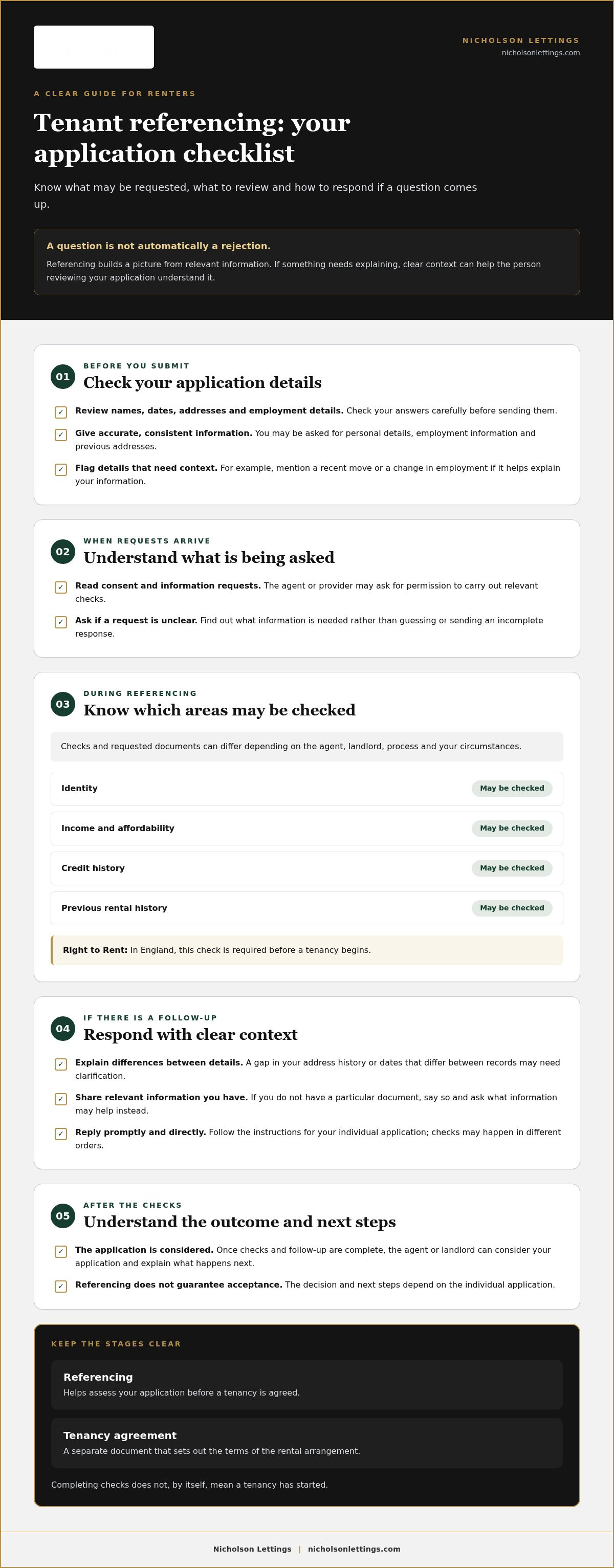
No. Referencing is part of the assessment before a tenancy is agreed. A tenancy agreement is a separate document that sets out the terms of the rental arrangement. Completing checks on your application doesn’t, by itself, mean a tenancy has started. Make sure you understand the next steps and the terms presented to you before proceeding.
It also helps to distinguish residential application checks from legislation discussed in broader landlord-and-tenant contexts. The Landlord and Tenant Act 1954 is associated in particular with business tenancies, so it isn’t a checklist for a residential referencing application. For renters, the practical focus is on what information is requested, why it may be relevant and how to clarify a question.
Keep the stages separate: referencing helps assess an application, while the agreement sets out the tenancy terms. If a check raises a question, ask for a clear explanation of what needs attention. That makes the process easier to follow as you work towards a decision on your application.
How does the tenant referencing process work, step by step?
The tenant referencing process UK renters experience usually follows a clear path, but the order and pace can differ between agents and referencing providers. Some checks may happen at the same time. Treat each request as part of your individual application, and follow the instructions you receive rather than relying on someone else’s experience.
Submit your application details. You may be asked for personal, employment and previous-address information. Read each question carefully and check your answers before sending them. Consistent details make it easier to match information across your application and supporting evidence.
Review consent and information requests. The agent or provider will explain what they need from you and may ask for permission to carry out relevant checks. Read the request so you understand what you’re being asked to provide. If a question is unclear, ask for an explanation instead of guessing.
Checks are carried out. These may cover different areas of your application, such as identity, income, credit or rental history. In England, a Right to Rent check is also required before a tenancy begins. The GOV.UK Right to Rent guidance explains the document-checking process.
Respond to follow-up questions. A provider may ask you to clarify details that don’t match or supply further evidence. For example, if your address history has a gap or dates differ between records, explain the circumstances clearly and provide any relevant information you have.
Receive an outcome and next-step information. Once the checks and any follow-up are complete, the agent or landlord can consider your application and explain what happens next. Completing a reference doesn’t guarantee acceptance. The decision and next steps depend on the individual application.
Application details and consent
Applications can request details such as your name, contact information, employment and previous addresses. Provide accurate answers that match your records where possible, and flag anything that needs context, such as a recent move or a change in employment. If you’re unsure what evidence is being requested, seek clarification before submitting an incomplete or inconsistent response.
Checks, follow-up and outcome
Checks don’t always run in a fixed order. A question from one part of the process may lead to a follow-up while other checks continue. Respond to each request directly. If you don’t have a particular document, say so and ask what information may help instead. There’s no single completion time for every application, so don’t treat a provider’s published figures as a general promise.
Prompt, accurate replies can help keep your application moving by reducing avoidable pauses for clarification. Keep an eye on the contact details you supplied and respond as soon as you can. If you’re starting a property search in the Liverpool City Region, Nicholson Lettings’ online form for prospective tenants is a practical place to begin.
What if your income, credit history or rental record is not straightforward?
A detail that needs explaining doesn’t automatically decide the outcome of your application. During the tenant referencing process UK renters may be asked for more context or supporting evidence if information is incomplete, unusual or doesn’t match across records. That follow-up is a chance to clarify what the reviewer has found, not a guarantee of acceptance or rejection.
Affordability is considered as part of the wider application, but there’s no single threshold or policy that applies to every landlord and agent. The reviewer considers the information available for your application and may ask questions to understand your circumstances. Don’t assume one income pattern, credit entry or previous renting issue tells the full story.
Explain relevant circumstances accurately and promptly, and answer any request as clearly as you can. If you’re uncertain what is being queried, ask which specific point needs clarification. A focused response is more useful than sending unrelated information or guessing what might satisfy the request.
Self-employment, variable income or a new job
Income can look different from one applicant to another. Self-employment, changing hours, variable earnings or a recent job change may mean your circumstances don’t fit a simple pattern. That doesn’t, on its own, determine whether an application will proceed. Read the request carefully and provide the information or evidence it asks for. If you’re not sure what is relevant, ask for clarification rather than assembling documents based on assumptions.
Credit concerns, limited history or a previous rental issue
A credit concern or short rental history may prompt questions, but it shouldn’t be treated as a complete account of your ability to rent. If you spot a factual mistake in information used for your application, explain what appears inaccurate and provide relevant context when asked. For a past rental issue, a brief, factual explanation can help the reviewer understand the circumstances without overstating or concealing them.
The reviewer considers the information available within the application process. They may need clarification before reaching an outcome, and the result depends on the individual application. Be open about a concern if it’s relevant, and keep your explanation consistent with the details you’ve provided elsewhere.
Income varies: Describe your circumstances accurately and respond to the specific evidence request.
Credit information concerns you: Identify any factual error and explain it clearly if asked.
Your rental record is limited or includes an issue: Give relevant context without assuming it will determine the decision.
A guarantor may be a possible route if the landlord or agent accepts one, but it isn’t an automatic option or a promise of approval. If it’s raised as part of your application, ask how it applies to your circumstances. Clear communication helps keep the discussion focused on the information that matters.
How can you prepare for tenant referencing and avoid preventable delays?
A little preparation can make it easier to complete an application accurately, especially when you’re also arranging a move, managing work commitments or changing address. The tenant referencing process UK renters go through can differ between applications, so use the specific instructions you receive as your guide. Gather the requested details, check them for consistency and watch for follow-up messages.
Information to organise before applying
Before you begin, read the application carefully and note which details or records it asks you to provide. Where possible, have the relevant information to hand so you can complete the form without guessing or leaving avoidable gaps. You don’t need to collect every possible document in advance; focus on what the application requests.
Check key details against your records. Names should be consistent, and dates, previous addresses and employment information should be accurate. If you’ve moved recently or your work circumstances have changed, make sure the information you enter reflects that clearly.
Review your contact details and make sure they’re current.
Check employment details and the contact information for any employer the application asks about.
Have relevant previous letting contact details available if requested.
Note any gaps or differences that may need a short explanation.
Take care with personal information. Before sending sensitive documents, check that the channel is the one specified for your application and that you’re responding to the correct contact. If a message or request seems unexpected, pause and verify it through a trusted contact route rather than sending documents to an unverified address or link.
What to do when a request or result is unclear
Don’t leave an unclear question unanswered or guess what it means. Reply calmly and promptly, referring to the specific point raised. If a name, date or address appears incorrect, explain what you believe is wrong and provide concise context. If you don’t have the requested information, say so and ask what alternative details would help clarify the point.
Keep your response focused. For example, if an address date doesn’t match because you moved part-way through a month, explain the dates plainly rather than sending a long account of your renting history. Retain copies of what you submit and any replies, so you can refer back to the same information if a follow-up arrives.
Preparation can reduce avoidable back-and-forth, but it can’t guarantee a particular outcome or completion time. If you’re planning your wider move alongside your application, you can explore luxury apartments in Liverpool with no deposit and learn about the available renting options. Keep your application details accurate, respond to requests, and ask for clarification whenever a step isn’t clear.
How Nicholson Lettings supports renters through referencing and the next steps
Referencing is one stage in finding a home, not the whole renting experience. Clear communication and practical support matter, especially when you’re balancing an application with work, a relocation or the arrangements involved in moving. Nicholson Lettings manages over 250 properties across the Liverpool City Region, with support for tenants beyond the initial application.
Local support for prospective tenants
Nicholson Lettings carries out rigorous tenant vetting as part of its approach to managing applications. For you, that means providing the information requested accurately and raising questions if an instruction or follow-up is unclear. A careful process considers the application details while allowing you to explain relevant circumstances when clarification is needed. It doesn’t guarantee a particular decision.
A dedicated Tenant Liaison Officer provides a named point of support for tenant queries. If you need help understanding a request or the next step in your rental journey, this clear contact role can make it easier to direct your question and understand the response. Referencing decisions still depend on the individual application, but you can get help understanding what a query is asking you to clarify.
For landlords, professional property management includes coordinating the processes that support a tenancy, from assessing applications to communicating with residents. For renters, that context is useful: referencing forms part of a managed relationship between the applicant, agent and landlord, rather than being an isolated form-filling exercise.
Nicholson Lettings supports renters across Liverpool, St Helens, Wigan, Manchester, Salford and Warrington. Its fully furnished luxury apartments and dedicated maintenance services can make the move-in experience more convenient, with support available for property-related queries.
After referencing: moving towards a tenancy
Once referencing is complete, the next steps depend on your application and the tenancy process for the property. You may receive an update or be asked for further information. If your application progresses, take time to read the tenancy details and understand what is expected before making arrangements around your move. Don’t assume that submitting information or completing checks means a tenancy has started.
If you’re waiting for an update, keep your contact details accessible and reply to any new request as clearly as you can. If you’re unsure what an outcome means, ask for an explanation of the next step. Nicholson Lettings’ Tenant Liaison Officer can support tenant queries, while your application is considered on its own information and circumstances.
Choosing a home is about more than passing checks. Consider the location, how the property is managed and what support is available once you move in. Nicholson Lettings offers fully furnished luxury apartments, with dedicated maintenance services as part of its rental offering. That can help you focus on settling in, rather than organising furniture or working out how property-related queries should be handled.
If you’re looking for a home in the Liverpool City Region, start your search by completing Nicholson Lettings’ online form for prospective tenants. Share what you’re looking for, provide accurate application details when requested, and take the next step with a clear understanding of the process.
Take the next step towards a home that fits
A rental application is one part of a bigger decision: choosing a place where you can feel settled and comfortable. As you continue your search, keep your priorities in view, from a location that suits your routine to the practical details that will make moving in easier. The tenant referencing process UK renters encounter is easier to approach when you treat questions as requests for clear information, rather than trying to predict the outcome.
When you’re ready, explore homes with Nicholson Lettings and take the next step at a pace that works for you. Start your property search with Nicholson Lettings and find a home that feels right for your next chapter.
A new home is a meaningful step. With clear information and thoughtful preparation, you can move forward with greater confidence and focus on settling in.
Frequently Asked Questions
Is tenant referencing a legal requirement in the UK?
No, tenant referencing checks such as credit and income assessments aren’t generally a legal requirement. In England, however, landlords must carry out Right to Rent checks on adult occupiers before a tenancy begins. This applies whether you’re applying in Liverpool, St Helens or elsewhere in England. The tenant referencing process UK renters encounter can therefore include both voluntary checks and a separate legal check, depending on the application.
How long does the tenant referencing process take?
There’s no set timeframe for every application. Timing can depend on how quickly information is returned, whether details need clarification and how the agent or referencing provider handles the checks. If an employer or previous landlord is asked to provide information, their response may also affect progress. Ask the agent what stage your application has reached, and check your messages in case they need a reply from you.
Can I rent in the UK if I am self-employed?
Yes, self-employment doesn’t automatically prevent you from renting. The agent or landlord may need information that helps them understand your income and circumstances, which can differ from standard employment records. Follow the application’s specific evidence request rather than sending a large bundle of unrelated paperwork. If your income varies or you’ve recently started working for yourself, explain that clearly and ask what information would help clarify your application.
What happens if I fail tenant referencing?
There isn’t one universal outcome called “failing” that applies to every application. The landlord or agent considers the information available and decides what happens next. Ask which part of the reference raised a concern and whether you can correct an error or provide context. If the application can’t proceed, request a clear explanation and consider what information you could prepare differently for your next application.
Can I use a guarantor if I do not meet an affordability assessment?
Possibly, if the landlord or agent accepts a guarantor for that application. A guarantor is someone who agrees to take on specified responsibilities if the tenant doesn’t meet certain obligations. Don’t assume this option is available or that it guarantees acceptance. If it’s raised, ask what the guarantor would need to provide and read any proposed agreement carefully so you understand the commitment before anyone signs.
Can I rent a property with no credit history?
Yes, having little or no credit history doesn’t automatically rule out renting. It may mean the reviewer has less information from that source, so they could consider other relevant details in your application or ask for clarification. Be straightforward about your circumstances, particularly if you’ve recently moved to the UK or haven’t used credit products. A limited file isn’t the same as a record showing missed payments.
Can a tenant check their own referencing report?
You can ask the agent or referencing provider whether they can share the report or explain a finding that affects your application. You can also review your own credit file through the relevant credit reference agency to check for unfamiliar accounts or incorrect details. If you want to understand how a credit search may affect your file, check the type of search used with the relevant provider.
What should I do if information on a referencing report is incorrect?
Tell the agent or referencing provider which detail appears wrong, where it appears and what you believe the correct information is. Keep the explanation brief and provide relevant supporting information if requested. If the error relates to a credit-file entry, contact the credit reference agency and the organisation that supplied the information to query it. Let the agent know you’re seeking a correction, and ask how to update your application once it’s reviewed.