
Letting Agent Fees for Landlords: The 2026 Guide to Costs and Value

Is the lowest percentage fee actually saving you money, or is it quietly eroding your property's value? In 2026, the cheapest letting agent is often the most expensive choice when you factor in lost yield and property depreciation. Understanding letting agent fees for landlords requires looking beyond the headline figure to see exactly what's happening behind the scenes of your investment.
You're likely feeling the pressure of recent legislative shifts, from the complexities of the Renters' Rights Act 2025 to the new digital tax requirements. It's natural to worry about hidden maintenance mark-ups or the risk of poor tenant quality under the now-mandatory periodic tenancies. We agree that the margin for error has narrowed, making professional, transparent management more vital than ever.
This guide provides a clear breakdown of property management costs and legal obligations specifically for the Liverpool City Region. You'll discover how to navigate selective licensing and maximise your rental yield whilst maintaining a truly hands-off experience. We'll show you how high-quality tenant sourcing and expert asset protection can turn a standard fee into a strategic advantage for your portfolio.
Table of Contents
Understanding the Letting Agent Fee Landscape in 2026
The 2026 rental market requires more than just a simple tenant search. With the Renters' Rights Act 2025 now in full effect, the administrative weight on property owners has doubled. This shift has fundamentally changed how we evaluate letting agent fees for landlords. Gone are the days of simple "set and forget" rentals; modern fee structures reflect the high level of risk mitigation and professional oversight required to protect your asset. Nicholson Lettings operates with total transparency across the Liverpool City Region, ensuring you understand exactly where your investment goes from day one.
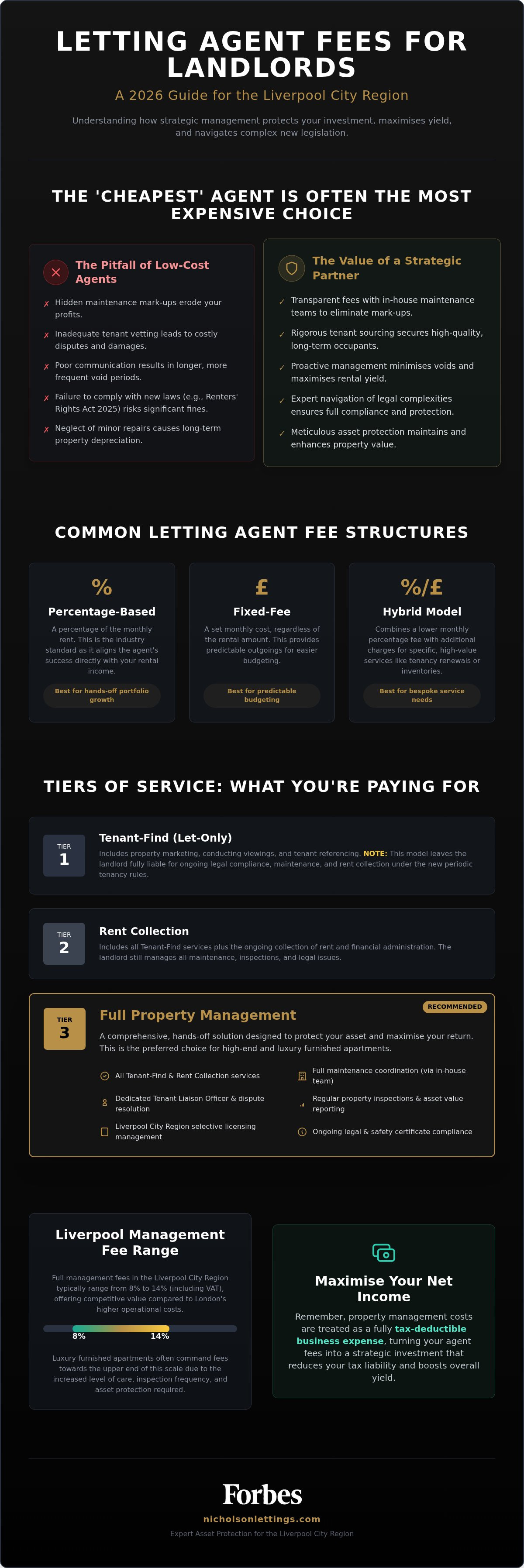
Fee structures generally fall into three categories: percentage-based, fixed-fee, or hybrid models. Percentage-based fees remain the industry standard because they align the agent's incentives with your rental income. Fixed-fee models provide predictable monthly costs, which some investors prefer for budgeting. Hybrid models often combine a lower monthly percentage with specific charges for high-value tasks. Each has its merits, but the priority should always be the value of the service provided rather than the lowest headline rate.
The Three Main Tiers of Service
Most providers offer three standard levels of support. Tenant-Find (or Let-Only) involves marketing, viewings, and referencing for a one-off fee. The 'Let-only' model is losing ground amongst professional landlords because it leaves the owner liable for the daily complexities of compliance and the new periodic tenancy rules. Rent Collection adds financial tracking and basic administration to the mix. Finally, Full Property Management offers the comprehensive, hands-off solution. It's the preferred choice for high-end assets, as it covers everything from maintenance to legal disputes. You can find more detail on typical Letting agent services and fees to see how these tiers traditionally differ.
Why Percentages Vary Across the UK
Regional location and property type significantly influence the cost. In London, fees often climb higher due to immense operational overheads; the North West offers more competitive rates. Research indicates that Liverpool management fees typically range from 8% to 14% inclusive of VAT. Luxury furnished apartments require a different level of care than basic unfurnished units. High-quality furnishings and sophisticated décor demand more frequent inspections and superior maintenance. For investors in St Helens or Wigan, local expertise ensures you aren't paying national-chain premiums for generic service that fails to protect your specific asset type.
The Cost of Full Management: What Are You Actually Paying For?
When evaluating letting agent fees for landlords, it's easy to focus solely on the monthly percentage. However, the true value of full management lies in the "invisible" administrative shield that protects your investment. This includes navigating the complexities of selective licensing in the Liverpool City Region, managing safety certificates, and resolving tenant disputes before they escalate. Adhering to the Tenant Fees Act 2019 guidance is a baseline requirement; high-end management ensures every interaction remains strictly compliant whilst protecting your yield.
A significant portion of your fee supports the work of a dedicated Tenant Liaison Officer. Their role is to maintain proactive communication, which is the most effective tool for reducing costly void periods. Unlike agencies that rely on external contractors with high mark-ups, we utilise an in-house maintenance team. This provides direct control over repair quality and costs, ensuring that your property is maintained to an exacting standard without unexpected financial surprises. Transparent letting agent fees for landlords should always reflect this level of direct, hands-on oversight.
Asset Protection and Maintenance
Luxury furnished apartments require a higher frequency of inspections to maintain their premium status. It's not just about fixing leaks; it's about preserving the aesthetic and functional value of high-spec interiors. Regular, documented visits allow us to identify minor wear before it becomes a major expense. This level of care is essential for properties in L1 or St Helens where tenant expectations are high. You can see our methodology in action by reading about Luxury Flat Maintenance in Liverpool, which details how we protect high-value assets through consistent vigilance.
Tenant Sourcing and Vetting
Modern tenant sourcing goes far beyond a simple listing on Rightmove or Zoopla. In 2026, finding a high-quality professional requires a sophisticated marketing strategy and a rigorous vetting process. We attract the best calibre of tenants by offering a deposit alternative scheme, which lowers the initial move-in cost without reducing your security. This is often paired with flexible tenancy agreements, making your property more desirable to mobile, high-earning professionals. Our referencing process is exhaustive, checking financial stability and previous rental behaviour to ensure your property is in safe hands. If you want to see how these dedicated maintenance services and sourcing strategies can stabilise your income, it's worth reviewing your current management plan.
Hidden Fees and the Tenant Fees Act: Staying Compliant
The Tenant Fees Act 2019 was a definitive shift in the rental landscape, fundamentally moving the cost of administrative tasks from the tenant to the landlord. When you're comparing letting agent fees for landlords, it's vital to look past the initial commission percentage. A competitive 8% or 10% headline rate can quickly become 15% once you factor in tenancy renewal fees, inventory charges, and check-out costs. These piecemeal charges often erode your yield, yet they are frequently omitted from the initial conversation. We believe in total transparency, ensuring you have a clear financial forecast for your portfolio from day one.
With all tenancies now periodic under the Renters' Rights Act 2025, the traditional "renewal fee" for a fixed term has become obsolete. However, some agents have replaced this with "tenancy administration" or "compliance review" fees. You must ensure your contract doesn't contain these legacy charges under a different name. Transparency in the initial contract is far more valuable than a low commission rate. At Nicholson Lettings, we operate with a "no hidden surprises" philosophy. We want our clients to feel the "premium care" of a service where logistical burdens and costs are managed with expert precision.
Banned Fees and Regulatory Compliance
Agents are legally barred from charging tenants for the majority of administrative tasks. As a landlord, you are now responsible for these costs, which is why they are often bundled into your management package. To ensure you're protected, always consult the Official Government Guidance on Landlord Fees. Beyond the fees themselves, compliance involves holding Client Money Protection (CMP) and belonging to an approved redress scheme. These aren't optional extras; they're essential safeguards. A checklist of what agents cannot charge tenants includes:
Referencing and credit checks.
Administrative or "set-up" fees.
Professional cleaning at the end of a tenancy.
Inventory or check-out charges.
We hold ourselves to the highest industry benchmarks, including RICS and ARLA standards, to guarantee that your funds and property are handled with professional integrity.
The Inventory and Check-In Debate
In the luxury market, the condition of your property is your primary asset. A professional inventory report provides the legal evidence required if a deposit dispute arises. Whilst some landlords attempt to save money here, an amateur report is often worthless in a tribunal. You should also watch out for agencies that apply heavy mark-ups to essential safety certificates, such as Gas Safety (CP12), EICR, or EPCs. These mark-ups are frequently hidden within the maintenance sections of your statement. Our in-house team helps avoid these third-party premiums, keeping your costs predictable and your asset protected. For a deeper look at staying ahead of the curve, read The Landlord’s Guide to Expert Property Management for comprehensive compliance tips.
Calculating ROI: Are Letting Agent Fees Tax-Deductible?
Investing in property is a business decision. Like any enterprise, understanding your net return is more important than looking at gross figures. When calculating your return on investment (ROI), letting agent fees for landlords must be viewed as a strategic expenditure rather than a simple cost. These fees are not just for finding a tenant; they are an investment in compliance, asset protection, and time management.
Tax Efficiency for Landlords
The most immediate financial benefit is that professional management fees remain a fully deductible business expense. Under current HMRC rules, you can deduct the full cost of your agent's services from your rental income before calculating your tax liability. Whilst fees reduce your gross income, they effectively lower your taxable profit. This ensures you only pay tax on what you actually earn. This deduction applies to the monthly management percentage, as well as costs for maintenance, insurance, and safety certificates handled by your agent.
A well-organised agent provides a detailed annual statement, which simplifies your self-assessment process and reduces the likelihood of accounting errors. By shifting the administrative burden to experts, you ensure every allowable expense is captured. This protects your margins against the backdrop of changing tax bands and digital reporting requirements in 2026.
The Real Cost of Voids
Many investors worry that a 10% or 12% management fee will eat into their profits. However, the math tells a different story when compared to the cost of a property sitting empty. A single month of void period represents approximately 8.3% of your annual rental income. If an agent's local expertise in St Helens or Wigan prevents just one month of vacancy through accurate pricing and proactive marketing, the service has effectively paid for itself for most of the year.
Local agents use real-time market data to ensure your property isn't over-priced, which leads to long voids, or under-priced, which leaves money on the table. In the Liverpool City Region, our tenant liaison officers focus on proactive retention. By addressing tenant concerns quickly through our in-house maintenance team, we foster long-term tenancies that stabilise your cash flow. Professional management also prevents costly legal errors. With the abolition of "no-fault" evictions, a mistake in a Section 8 notice or a failure to provide correct compliance documentation can lead to months of lost rent and expensive legal fees. A single legal error often costs more than several years of management fees.
If you are ready to protect your yield and streamline your portfolio, consider how our fully managed property services can enhance your ROI.
Choosing the Right Partner in the Liverpool City Region
In the Liverpool City Region, the distance between a high-yield investment and a depreciating asset often comes down to local boots on the ground. National online platforms might offer lower headline rates, but they lack the granular insight needed to manage properties in L1, St Helens, or Wigan effectively. They can't walk the streets to check on a property, nor do they understand the specific nuances of local selective licensing schemes that can catch out the unwary. When comparing letting agent fees for landlords, the value of an agent who truly knows the local landscape is immeasurable.
Transitioning from self-management or a poor-performing agent is simpler than many investors realise. You don't have to wait for a tenancy to end to make a change. A professional partner handles the entire handover process, from collecting keys and compliance documents to introducing themselves to your tenants. This shift often provides an immediate uplift in property standards and tenant satisfaction, which are the two primary drivers of long-term asset growth. Investing in quality management is a commitment to the future value of your portfolio.
Questions to Ask Your Potential Agent
Before signing a management agreement, you must look beyond the percentage. Ask specifically if they have an in-house maintenance team or if they rely on external contractors. Agencies using third-party contractors often apply mark-ups to every repair, which can quietly double your maintenance spend over a year. You should also ask how they handle tenant communications and emergency repairs. In the era of periodic tenancies, a slow response to a leak or a broken boiler is the fastest way to lose a high-quality tenant. For a comprehensive list of criteria to evaluate, read our guide on Choosing the Best Letting Agents in Liverpool.
The Nicholson Lettings Approach
We manage over 250 luxury properties across the region, and our "premium care" ethos is built into every interaction. Our dedicated Tenant Liaison Officers act as a single point of contact for your residents, ensuring that small issues never escalate into costly disputes. This proactive style is why our letting agent fees for landlords represent such a strong return on investment; we focus on preserving the high-spec finish of your luxury furnished apartments whilst keeping void periods to an absolute minimum. Our in-house maintenance team gives us total control over repair quality, ensuring your property remains an elite asset. If you're ready for a more professional, hands-off experience, enquire about our property management services today and let us protect your investment.
Maximising Your Yield in a New Era of Property Management
The 2026 rental landscape demands a shift from viewing letting agent fees for landlords as a simple overhead to seeing them as a strategic tool for growth. Success now hinges on total transparency and the ability to navigate complex compliance requirements whilst maintaining the high standards of your luxury assets. By prioritising a partner who offers direct, hands-on oversight, you ensure your portfolio remains resilient against legislative changes and market fluctuations.
Nicholson Lettings brings award-winning local expertise to every property we handle. With over 250 properties managed across the North West, we understand how to protect your investment through our dedicated in-house maintenance team and proactive tenant liaison officers. This "premium care" approach handles the logistical burdens so you don't have to, turning potential risks into predictable returns. It's time to elevate your property management experience and secure the long-term value of your rental portfolio.
Secure Your Investment with Nicholson Lettings Property Management and experience the difference that expert local support makes to your bottom line. We look forward to helping you achieve a truly hands-off, high-yield investment journey.
Frequently Asked Questions
What is the average letting agent fee for landlords in Liverpool?
Average management fees in Liverpool typically range between 8% and 14% inclusive of VAT. This rate is generally more competitive than London averages but varies based on the level of service and property type. For luxury furnished apartments, fees reflect the increased intensity of maintenance and tenant care required to protect the asset value. It's essential to check if a quoted percentage includes VAT to avoid unexpected costs on your monthly statement.
Are letting agent fees tax-deductible for UK landlords?
Yes, letting agent fees for landlords remain a fully deductible business expense under current UK tax rules. You can subtract the total cost of management and tenant sourcing from your gross rental income before calculating your tax liability. This includes the monthly management percentage, inventory costs, and maintenance coordination. Using a professional agent ensures you receive detailed annual statements, making your self-assessment process much simpler and more accurate whilst protecting your overall rental yield.
What is the difference between a let-only fee and full management?
A let-only service primarily covers marketing, viewings, and tenant referencing for a one-off fee. Once the tenant moves in, the landlord handles all daily management and compliance. Full management is a comprehensive, hands-off solution. It includes rent collection, maintenance coordination, and ongoing tenant liaison. In 2026, many professional landlords prefer full management to ensure they remain compliant with the Renters' Rights Act 2025 and avoid the heavy administrative burden of rolling periodic tenancies.
Can letting agents charge landlords for tenancy renewals?
Under the Renters' Rights Act 2025, fixed-term tenancies have been replaced by periodic contracts. This means the traditional renewal fee for extending a fixed term is largely obsolete. However, some agents may charge a fee for periodic compliance reviews or rent assessments. You should check your management contract for any legacy renewal charges. We prioritise transparency at Nicholson Lettings, ensuring our fee structure reflects the current legal reality without hidden administrative surprises for our clients.
How does the Tenant Fees Act 2019 affect what I pay my agent?
The Tenant Fees Act 2019 prohibited agents from charging tenants for referencing, administration, and credit checks. Consequently, these operational costs shifted to the landlord. You'll find that letting agent fees for landlords now often include these administrative tasks as part of a set-up or tenant-find fee. It's a legal requirement to follow these rules. Any agent attempting to charge tenants for these services could face significant fines and a loss of their professional accreditation.
Is it worth paying for full property management in 2026?
Professional management is more valuable in 2026 than ever before due to increased regulatory complexity. The abolition of no-fault evictions means every aspect of tenancy management must be legally watertight. A dedicated agent protects your yield by reducing void periods and ensuring high-quality tenant sourcing. For luxury properties in the Liverpool City Region, the asset protection provided by a dedicated maintenance team and liaison officer far outweighs the cost of the monthly management percentage.
What hidden costs should landlords look for in a management contract?
Landlords should be wary of maintenance mark-ups, where agents add a percentage to third-party contractor invoices. Other common hidden costs include separate charges for inventory reports, check-out inspections, and deposit dispute handling. You should also verify if there are additional fees for managing emergency repairs or overseeing major works. A transparent contract should clearly list every potential charge, ensuring you can accurately calculate your net rental yield without being caught out by unexpected expenses.
Do I have to pay letting agent fees if the property is empty?
Most percentage-based management fees only apply when rent is being collected. If your property is empty, you usually won't pay a monthly management fee. However, you might still incur costs for void management if you require the agent to perform regular inspections or oversee maintenance whilst the property is vacant. It's important to clarify these terms in your agreement. Proactive agents focus on high-quality tenant sourcing to ensure these void periods are kept as short as possible.


