
Renting without large deposit Liverpool: 2026 price levels and models

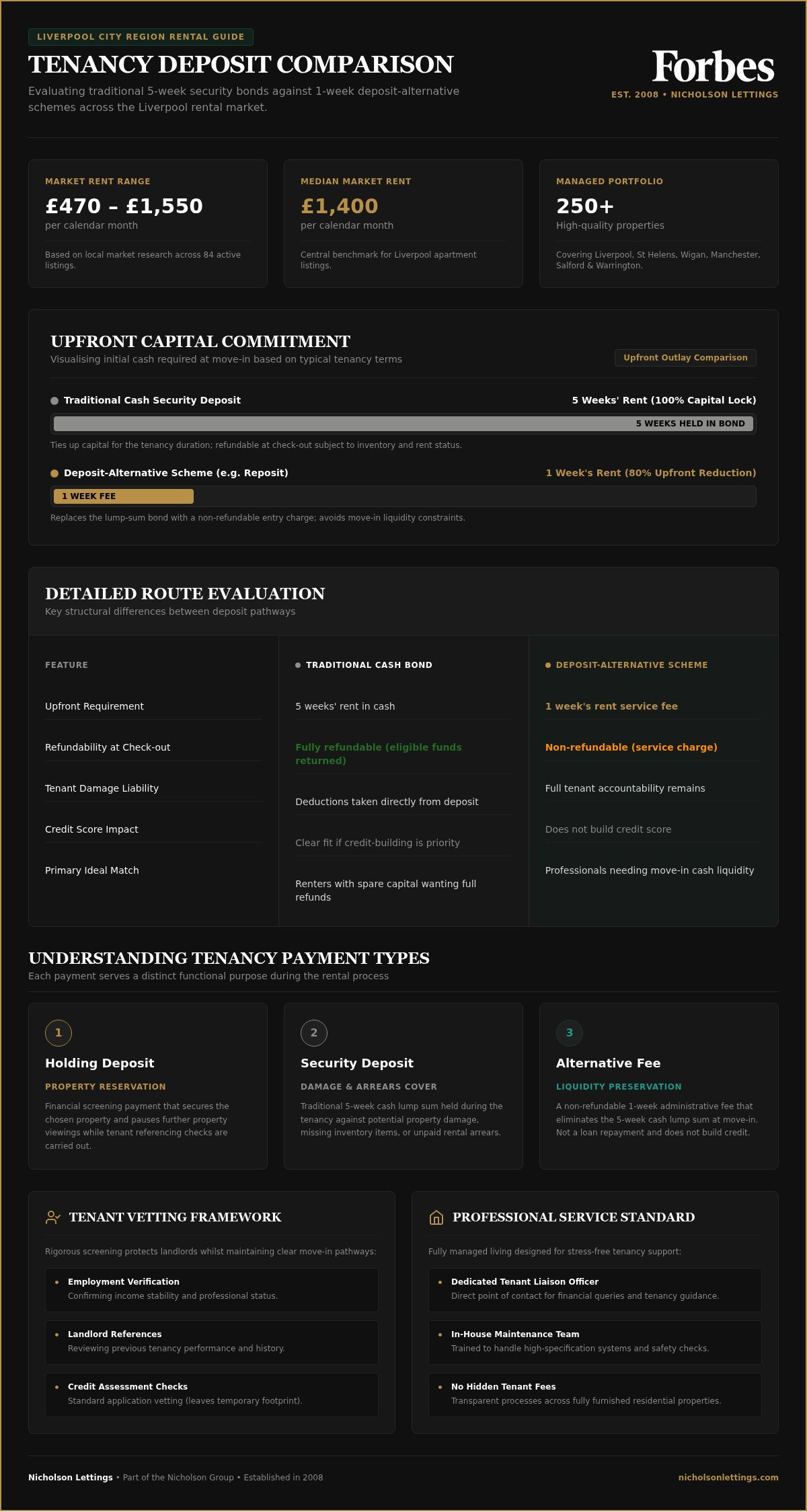
In the current Liverpool rental market, typical rents range from £470 to £1,550 per month, and market research across 84 listings puts the median at £1,400 per month. The decision in front of you is practical: lock five weeks of rent in a cash deposit, or move in through a deposit-alternative scheme that replaces that lump sum with a small non-refundable fee. Either path can secure a high-quality home across the Liverpool City Region; the right one depends on whether you need cash free at move-in, want a full refund at check-out, or prefer fully managed living with less day-to-day admin.
Key Takeaways: You can rent in Liverpool without a large deposit by paying a non-refundable fee equal to one week's rent instead of five weeks' cash.
The Reposit model replaces a five-week cash bond with a one-off fee, freeing up your liquidity.
Skip the alternative scheme if you want a full refund because these service fees are non-refundable.
This route is best for professional tenants who need to preserve cash for furnishings or move-in costs.
Market data from 84 listings shows Liverpool rents range from £470 to £1,550 per month.
Table of contents
Pick the 2026 rental path that matches how you use cash
Before you shortlist homes, match the tenancy model to the move you are actually making:
You need cash free for the move, furnishings or living costs: use a deposit-alternative scheme and pay a non-refundable fee equal to one week’s rent rather than five weeks upfront.
You have funds to spare and want every eligible pound back at check-out: pay a traditional security deposit and keep the refund path clear.
You want hassle-free living as a busy professional: choose full management and a fully furnished home, with a Tenant Liaison Officer handling day-to-day contact.
Market research across 84 listings places local rents between £470 and £1,550 per month (median £1,400). A cash deposit on that band ties up a large sum for the life of the tenancy; a deposit alternative avoids that liquidity trap by swapping the lump sum for a one-off non-refundable fee. Full management suits you if you want repairs and admin handled without chasing contractors yourself. Regional detail on how modern no-deposit tenancies run is covered in this St Helens deposit guide.
You pay no tenant fees here, and a dedicated Tenant Liaison Officer walks you through each step toward a move-in-ready home. Request a quote when you are ready to compare options.
One week’s rent fee can replace a five-week cash deposit
If you have found a furnished apartment you want but cannot spare five weeks’ rent as a bond, a deposit-alternative scheme is built for that gap. It replaces the cash lump sum with a lower non-refundable fee while leaving you fully accountable for damage and unpaid rent.
On the same 84-listing market band, high-spec Liverpool apartments still sit between £470 and £1,550 per month. With Reposit you pay a non-refundable fee equal to one week’s rent at the start of the tenancy instead of lodging a substantial cash sum. Treat the fee as an entry cost, not a savings pot: it is not returned at the end, yet your wider capital stays available for the move. You still cover end-of-tenancy charges where you are liable. For professional tenants, that trade-off frees capital on day one. Cost context for the city is set out in this Liverpool renter’s guide. The process is designed to keep furnished move-ins clear and predictable.
Tip: Using a Reposit deposit alternative option reduces upfront costs to just one week's rent rather than five weeks' cash deposit.
Holding deposits reserve a home; security deposits cover damage
When a listing is close to going, you need to know which payment does what. A holding deposit is financial screening that secures the property and pauses other viewings while checks run. A security deposit is different: it sits against damage, missing items or rent arrears during the stay.
Lodging a full cash security deposit still creates a liquidity trap if you need that money elsewhere. A deposit alternative avoids tying up the larger sum, though you remain responsible for damage you cause. The holding deposit only holds the home during referencing; it is not the same pot as the tenancy bond.
On current market listings, rents in the region typically fall between £470 and £1,550 per month. Managed, fully furnished stock reduces the number of parallel tasks you juggle during the move. Use this Liverpool area guide while you narrow locations, and lean on clear process support from the team when you are ready to apply.
Non-refundable alternative fees do not build your credit score
If your goal is a stronger credit file, read the fee terms carefully before you opt out of a cash bond. Non-refundable deposit-alternative fees do not build your credit score, because those payments are not reported to credit reference agencies as credit agreements.
Tenants sometimes treat the fee like a loan instalment. It is a service administration charge, not debt repayment, so on-time payment does not raise your rating. Missed payment can still harm your profile. Hard credit checks at application leave a temporary footprint of their own.
Tenant screening here includes employment verification, previous landlord references and credit checks. That vetting protects the landlord without forcing you to lock five weeks of rent in a bond. Deposit alternatives remove the liquidity trap, yet they do not replace the credit-building role a well-reported credit product might play. If building credit is your primary focus, a traditional deposit is the clearer fit. Ashley Babbs handles referencing in a structured, professional way.
A commenter in the getagent.co.uk thread "Forum Sales & Lettings | Reviews & Performance, GetAgent":
"I’ve been using the services of Forum Lettings since 2006 and they have found many tenants all of which have been top quality. Ashley Babbs is professional in everything relating to finding and completing a tenancy agreement from vetting, contracting and credit referencing." (source)
That feedback lines up with a screening process built on vetting, contracting and credit referencing before keys are released. For move-stage detail, see this stress-free move guide.
4 Steps to secure a Liverpool home with low upfront cash
You cut move-in cost and delay when documents and deposit choice are ready before you offer. Local private rents typically sit between £470 and £1,550 per month (median £1,400 on market listings), so knowing your upfront route early keeps offers credible.
Complete referencing: Submit income details for rapid financial screening and holding-deposit checks.
Select deposit options: Choose a traditional cash bond or a deposit-alternative scheme so you are not forced into a liquidity trap.
Review terms: Confirm no-fee policies and the exact wording on fees, damage liability and check-out.
Finalise check-in: Sign documents and collect keys for immediate move-in.
Vicky and Andy in Sefton needed speed. The team painted and cleaned the flat, supplied new furniture, and finished referencing plus administration in three days. They described a friendly staff team that made the place feel homely straight away and said the agency exceeded what they had expected. Preparation on both sides removed the usual moving friction. Premium fully furnished homes add immediate comfort without a separate furniture budget; ask for a tailored quote on homes that fit your dates.
Cash deposit or one-off alternative: what you pay and what returns
Side-by-side, the two upfront models answer different money questions. On the open market band of £470 to £1,550 per month (median £1,400 across the 84 listings), a traditional cash deposit is a refundable lump sum that locks capital for the tenancy. A deposit alternative removes that trap by charging a non-refundable one-off fee instead of a returnable bond.
Over a long stay the non-refundable fee is money you will not see again, so it suits you when flexibility at move-in matters more than recovering that slice of cash. A cash deposit suits longer stays where you expect a full eligible refund after a clean check-out.
Clear tenancy terms keep your total initial cost predictable across the Liverpool City Region. Straightforward guidance is available so you can compare both routes against the same property before you commit. Speak to the team when you want figures on a specific home.
When a traditional security bond is the stronger choice for you
Choose a cash bond when you want a realistic path to full return of eligible funds at contract end and you can spare the capital now.
Landlords who run larger portfolios often prefer standard cash security because liability boundaries stay simple and unpaid damage is easier to settle from a held sum. Upfront security reduces dispute risk later. Deposit alternatives still avoid the liquidity trap for tenants who need cash free, but their fees are non-refundable by design. Your cash in a conventional bond stays ring-fenced for the tenancy, then comes back after a successful check-out when obligations are met.
Standard upfront security therefore fits tenants with spare cash who want no ongoing alternative-fee cost. For Liverpool stock, protection terms are set out in plain language before you sign.
Client money protection and active maintenance standards
How your money and the property are handled after move-in matters as much as the deposit model you pick. Market listings again place local rents between £470 and £1,550 per month.
Maintenance does not wait for weekdays. During a routine preventative check at Nicholson House, technicians caught a slight efficiency drop in the primary heating and ventilation system, started a repair programme at once, and coordinated access through Tenant Liaison Officers while residents were at work, so rooms never went cold. Acting early stops minor faults becoming major damage.
Client funds sit with written confirmation that they cannot be combined with, or used to offset, other company debts. A maintenance and facilities manager may also inspect completed house repairs to verify quality, cleanliness and correctness. Lettings maintenance needs steady attention if homes are to stay safe and liveable.
A commenter in the ukbusinessforums.co.uk thread "Estate & Letting Agents, Start up thoughts from my experience":
"I think it gets worse year on year, you will need significant resource to even manage 40+ properties. For me lettings is essential as it your only real guaranteed regular income." (source)
Large portfolios need real resource and daily maintenance discipline. Segregated client accounts plus active quality checks give you the structure behind a calmer tenancy.
Frequently asked questions
How does a deposit-alternative scheme work for luxury apartments?
A deposit alternative lets you pay a smaller fee instead of a large cash bond. With Reposit you pay a non-refundable fee equal to one week’s rent at the outset rather than lodging five weeks’ rent. The route applies to studio rentals and high-spec homes across the region. You remain responsible for end-of-tenancy damage and unpaid rent.
Is a holding deposit different from a security deposit?
Yes. A holding deposit reserves the property while tenant vetting runs: employment verification, previous landlord references and credit checks. A security deposit covers potential property damage and related liabilities during your stay. Applications run with no hidden tenant fees, so the steps stay visible from offer to keys.
What happens to my money if I choose a traditional cash deposit?
Your funds remain in a dedicated client account for the life of the tenancy. Written confirmation states that client funds cannot be combined with or used to offset other company debts, which protects you against bank set-off. Separately, the in-house maintenance and facilities manager may audit completed maintenance so the home stays in sound condition.
How much does a no‑deposit house cost per month?
Market listings place local rents between £470 and £1,550 per month (median £1,400 across 84 listings). Your figure depends on size, location and furnishings. The firm manages over 250 properties across Liverpool, St Helens and Wigan. Contact the office for a personalised quote on the home you want.
Where are the listed properties located?
Managed homes sit across the North West, including Liverpool City Centre, St Helens, Wigan, Manchester, Salford and Warrington. Feedback from Vicky and Andy in Sefton describes prompt support that helped them settle quickly. Each property includes access to the dedicated maintenance team.
Moving Forward in 2026
The core choice has not changed since the opening lines: preserve liquidity with a one-week Reposit-style fee, or lodge a traditional bond you can reclaim after a clean check-out, while still expecting secure funds handling and maintained homes. Avoiding a large locked deposit keeps moving costs workable; you only need to read non-refundable fee terms with the same care you give any tenancy clause.
CEO Paul Nicholson and facilities manager Kevin centre the operation on transparent, high-standard living. Recognised as Smaller Apartment Scheme of the Year, the firm protects client money with bank set-off protection and runs quality audits on maintenance across the portfolio. Browse homes through the Liverpool letting agents guide, then get in touch to secure the next place that fits your budget and dates.


