Average Utility Bills in a Warrington Flat: 2026 Guide

There’s no single figure that reliably captures the average utility bills apartment Warrington renters will face. Two flats in the same area can have very different bills, depending on their size, energy efficiency, occupants and everyday habits.
If you’re weighing up a move, it’s reasonable to want a clear monthly budget before you commit. Bills can feel uncertain when it’s not clear which services are covered by rent, and colder months can bring a noticeable change in energy use. A headline average won’t tell you what your household is likely to pay.
This guide explains which bills to factor in, what to check about a flat before moving, and how meters, property efficiency and seasonal routines affect your estimate. You’ll also learn how to compare homes by their likely household bills, not just their rent or furnishings. Nicholson Lettings supports renters in Warrington and across Liverpool, St Helens, Wigan, Manchester and Salford with furnished homes, tenant liaison and dedicated maintenance support, helping make the practical side of renting easier to manage.
Table of Contents
What counts as an apartment utility bill in Warrington?
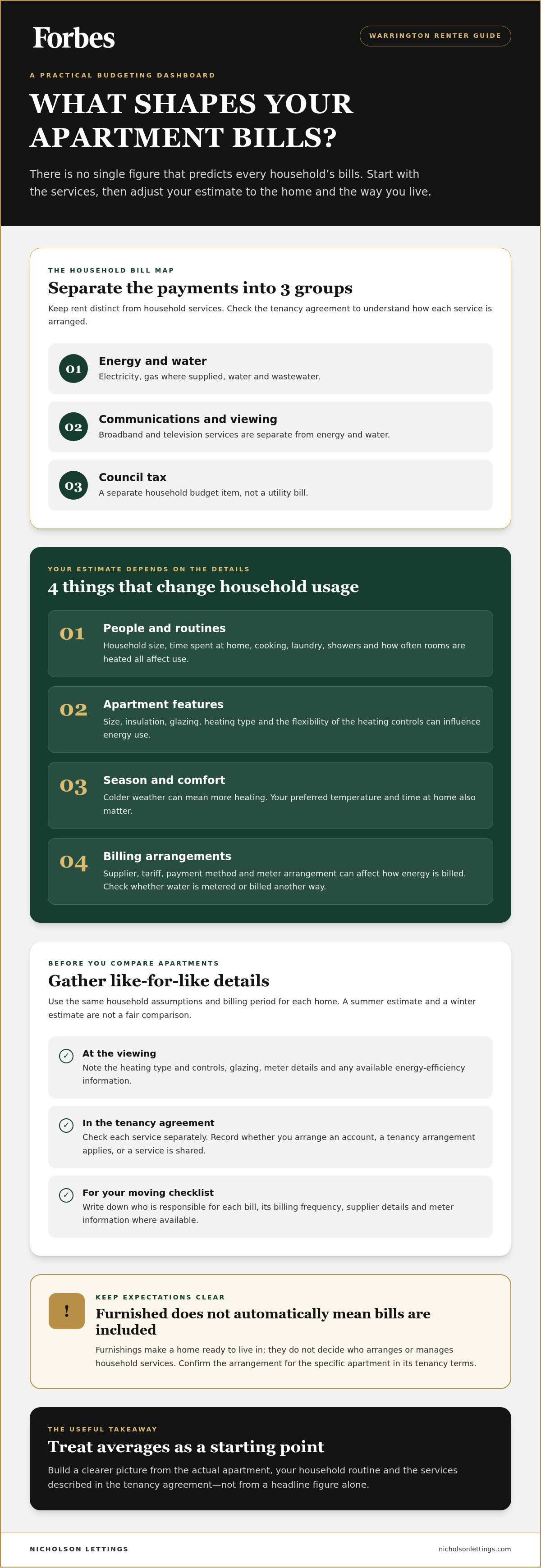
For budgeting, separate the services that keep a home running from the payment for the home itself. Rent and utilities are distinct parts of a tenancy: rent relates to occupying the apartment, while utility bills cover household services. The tenancy agreement sets out how those services are arranged, so use it to identify your responsibilities rather than assuming every renter pays each supplier directly.
Which bills might an apartment renter pay?
The main household services to account for are electricity, gas where supplied, and water and wastewater. Depending on the apartment’s setup, these may involve separate accounts or a different arrangement described in the tenancy terms.
Keep other services in separate categories. Broadband provides internet access, while television services relate to viewing and may have their own arrangements. Neither is an energy or water utility. Council tax is also a separate household budget item, not a utility bill.
Energy and water: electricity, gas if supplied, water and wastewater.
Communications and viewing: broadband and television services.
Separate household item: council tax.
This classification helps you direct questions to the right place and avoid treating every regular household payment as one bill. An electricity account and a broadband subscription, for example, cover different services and may be arranged separately.
Are utilities included in the rent?
That depends on the tenancy agreement and the arrangement for the specific property. A furnished apartment doesn’t automatically mean utilities are included. Furnishings make the home ready to live in; they don’t determine who arranges or pays for household services.
Read the agreement for each service separately. Note whether you’re expected to set up an account, whether a service is handled through an agreed tenancy arrangement, or whether a shared arrangement applies. If the paperwork groups services together, record what it covers and how your responsibilities are described.
Keeping these categories clear from the start makes it easier to organise your move. You can distinguish rent from utility accounts, broadband, television services and council tax, then keep the relevant tenancy details with the paperwork you’ll need when setting up your household.
What changes average utility bills in a Warrington apartment?
An apartment’s energy use depends on how people live in it as well as its physical features. A smaller flat may need less energy to heat than a larger home, but the number of occupants, time spent indoors and preferred comfort level all affect consumption. That’s why an average utility bills apartment Warrington figure can only be a starting point, not a prediction for your household.
Separate usage from the terms that shape your bill. Your supplier, tariff, payment method and meter arrangement can affect how energy is billed. For current guidance on tariffs and consumer rights, consult Ofgem, the UK's energy regulator. For water, find out whether the apartment has a meter or another billing arrangement.
How do apartment size and daily routines affect usage?
One occupant may use less hot water and fewer appliances than a household sharing the same flat, but routines matter too. Several people cooking, washing and using hot water at different times can increase household demand. Someone who works from home may also use heating, lighting and kitchen appliances for more hours than a resident who is usually out during the day.
Think through a typical week before estimating use. Note how often you cook, do laundry, take showers and heat rooms, as well as how many people will be home during the day. These details create a more useful picture than household size alone. If your routine changes by season, allow for that as well.
Why do building features and seasons matter?
Insulation and glazing can affect how quickly a flat loses heat and how much heating it needs to stay comfortable. Heating controls matter too: a timer or room thermostat can help you match heating to your routine, while less flexible controls may make it harder to avoid heating an empty home. Don’t assume two apartments in the same building have identical features.
Ask for available property information and note the heating type, controls, glazing and any energy-efficiency details. At a viewing, check how the controls work and whether you can see the meters. You don’t need to assign a rating yourself; the aim is to gather useful facts for a fair comparison.
Expect usage to shift with the seasons. Colder weather can mean more heating, though the change depends on the flat’s features, the temperature you prefer and how long you’re at home. Compare estimates over the same period and use similar assumptions about occupancy and heating habits. Otherwise, a summer estimate for one apartment may look deceptively favourable beside a winter estimate for another.
Before settling on an estimate, record the supplier, tariff type, payment method and meter details where available. Add these to your moving checklist. If you’re looking for a furnished home with support through the renting process, explore Nicholson Lettings’ home-finding support.
How can renters compare Warrington apartment bills fairly?
A fair comparison needs more than a rent figure and a headline average. The average utility bills apartment Warrington estimate you find may use different assumptions from your own household or describe a different billing arrangement. Set up a side-by-side record to see what each estimate covers and which details are still unknown.
Use the same household profile for each apartment. If one estimate assumes a single occupant who is out most of the day and another assumes a shared household with someone working from home, the figures aren’t directly comparable. Keep the billing period consistent too, and record the date and assumptions beside every estimate.
What information makes two estimates comparable?
Start with the apartment’s size, the number of occupants and the time people expect to spend at home. Then note the heating type, usual heating routine and any available information about energy efficiency. These details help explain why two estimates may differ, without assuming that similar-looking flats have the same usage.
Next, mark each service as included under the tenancy arrangement, billed separately or managed through a shared arrangement. Keep rent and council tax in separate rows from utilities. A supplier estimate is an indication based on its stated assumptions; an actual bill records usage and billing terms for a particular period. Don’t treat one as the other.
Comparison checklist
Apartment: size, heating type and available energy information.
Household: occupancy, time at home and expected heating habits.
Tenancy: rent, services included and any shared billing arrangements.
Separate bills: electricity, gas where supplied, water and wastewater, and council tax.
Evidence: estimate or actual bill, date, billing period and assumptions.
This layout makes differences visible. If one home’s information is based on a supplier estimate and another’s on an old bill, label that clearly rather than presenting them as equivalent. Third-party averages can offer context, but they aren’t Nicholson Lettings’ charges or guaranteed bills for your household.
Which sources should renters use for current estimates?
For energy-market information, use Ofgem, the UK's energy regulator. Refine an estimate with supplier information and property-specific details, such as the heating system and meter arrangement. For water and wastewater in Warrington, consult United Utilities’ current billing guidance and use the arrangement that applies to the apartment.
Keep source details alongside your comparison, including the date you checked them. Guidance and supplier estimates can change, so an undated figure may not help you assess a future tenancy. Before deciding, compare all regular household commitments while keeping rent, utilities and council tax distinct. For support finding a furnished home, explore Nicholson Lettings’ home-finding support.
How to estimate your apartment utility bills before moving
Once you understand the tenancy arrangement and the apartment’s setup, turn that information into a working budget. The aim is to know what needs arranging before move-in, when payments are due and how you’ll check whether your plan matches your household’s actual use.
A four-step pre-move bill check
Step 1: Confirm account responsibilities. Use the tenancy paperwork to identify which services you need to arrange yourself. For each one, note whether you’ll need to open a new account or follow an existing arrangement, and write down anything that needs clarification before the tenancy begins.
Step 2: Prepare for the handover. Find out how utility account responsibility transfers at the start of the tenancy and what information you’ll need to provide to suppliers. Make a reminder to record meter readings on the day you take possession, where meters are accessible, and keep those readings with your move-in documents.
Step 3: Set up a realistic planning figure. Use relevant supplier estimates to plan for services you’ll manage directly. Don’t treat a projected payment as a final bill. If you’re unsure how a supplier has arrived at an estimate, use its account information or billing support to understand the assumptions.
Step 4: Schedule a review. Put a reminder in your calendar to revisit your budget after you’ve received your first statements. This gives you a prompt to adjust your planned payments if actual usage or the account setup differs from what you expected.
A simple tracker can help keep the process manageable. Give each service its own line and add the account setup status, next action and payment date once known. That way, you can see at a glance whether a service is ready for move-in or still needs attention.
How can renters keep monthly budgeting clear?
Keep your household budget organised by separating rent from utilities, council tax and optional services. You can still view the total you need to plan for, but separate categories make it easier to spot a missing account or a change in a particular bill. If you share the apartment, agree how you’ll record and manage household payments together.
After moving, compare supplier statements with your own records and meter readings where available. Keep copies of bills and note any changes to payment arrangements, so you can understand how your monthly plan develops over time. A reading-based bill and a supplier estimate may differ; if a statement doesn’t make sense, contact the relevant supplier rather than assuming the estimate was the amount due.
Getting these practical tasks organised can make moving day feel less demanding. For support finding a furnished home, explore Nicholson Lettings’ home-finding support and take the next step towards a more manageable move.
Choosing a Warrington rental with bills and support clearly understood
Once you’ve developed a household budget, use it alongside your priorities for the home. A rental should fit how you live as well as the amount you’re prepared to set aside each month. Keep rent, household bills and council tax as separate categories in your decision, then consider whether the tenancy terms and property-management process are clear enough for you to plan with confidence.
It can help to rank your needs before choosing: for example, space to work from home, a convenient location or a tenancy arrangement that suits your plans. This gives you a consistent way to assess different homes without letting one appealing feature distract from the practical details.
What should renters check during property viewings?
Use the viewing to consider how the apartment would work for your everyday routine. Check that the layout suits the way you expect to use the rooms, and note practical questions that could affect your decision. If you’re comparing several homes, write down your impressions straight after each viewing so details don’t blur together.
Also look beyond the initial move-in. Read the tenancy paperwork for the process to follow if something in the property needs attention, and note which responsibilities sit with you. Clear instructions help you understand what to do and who to approach, rather than having to work it out under pressure later.
How can managed renting make the process easier?
A well-organised renting experience depends on more than the apartment. It also helps to understand how tenancy questions are handled, how property issues are reported and what happens after you raise one. Before deciding, consider whether the information you’ve received makes those steps easy to follow. Clear processes can make day-to-day renting feel more straightforward.
For landlords and renters alike, clearly stated responsibilities help avoid confusion. Keep the tenancy documents somewhere accessible and refer to them if you need to check a process. If a point is unclear before you commit, get a plain explanation of how it works so you can make an informed choice.
Your decision doesn’t need to rest on one average or one feature. Consider the apartment, the household arrangements and the experience of renting it as a whole. Nicholson Lettings helps renters explore home options in Warrington and across Liverpool, St Helens, Wigan, Manchester and Salford. If you’re ready to take the next step, explore the home-finding support available and find a home that fits your plans.
Take your next renting step with confidence
Use your bill checklist to decide what you need from a home before you make your choice. A useful budget is personal: the average utility bills apartment Warrington figure can provide context, but your tenancy terms, household routines and the property itself should guide your planning.
Comfort and practical support matter too. Nicholson Lettings manages more than 250 properties across the Liverpool City Region and serves renters in Warrington. Pairing a home that suits your routine with clear tenancy information can help make the move feel more manageable.
If you’re ready to explore your options, take a relaxed next step and find a furnished home with Nicholson Lettings. With dedicated tenant liaison and maintenance support, you can approach your move with greater confidence and focus on settling in.
Frequently Asked Questions
Are utilities usually included in apartment rent in Warrington?
Not always. Whether any household services are included depends on the individual tenancy arrangement, so check the agreement rather than relying on what’s common elsewhere. For example, electricity might be arranged by the tenant while another service is handled differently. Make sure you know who sets up each account, who receives the bill and how shared services are divided before you compare apartments.
Is council tax included in average utility bills?
No. Council tax is a separate household budget item, not a utility bill. Its amount depends on the property’s council tax band and the applicable local charge. For a Warrington flat, check the property’s band through the Valuation Office Agency and include council tax as its own line in your budget. That gives you a clearer view of household commitments without mixing it into energy or water estimates.
Can two apartments in the same Warrington building have different utility bills?
Yes. Even within one building, occupants may have different routines, heating preferences and time at home. Flats may also differ in their layout, exposure to outdoor walls or available heating controls. For example, a household that heats rooms throughout the day may use energy differently from one that is usually out. Compare details for the specific apartment, not just information from another resident.
Does a furnished apartment use less energy?
Not simply because it’s furnished. Furniture can make settling in easier, but it doesn’t show how well a flat retains heat or how much energy its heating system uses. Your consumption still depends on the property’s features and how you use heating, hot water and appliances. Treat furnishing and energy efficiency as separate considerations when assessing a home and planning your household budget.
How can I estimate bills before I move into an apartment?
Start with the tenancy terms and details about the specific flat, then build an estimate around your household’s expected routine. An average utility bills apartment Warrington estimate can offer context, but it won’t account for your occupancy or heating habits. For a more tailored picture, use current supplier information and any property-specific details available, and keep the date and assumptions beside each estimate for later review.
Can my utility bills change during the tenancy?
Yes. Your energy use can rise or fall as seasons, household routines and the number of people at home change. Supplier terms or tariffs may also change, affecting bills even if your routine stays similar. If a statement differs from your expectations, compare its billing period and usage with earlier statements. Keeping records helps you identify whether the difference relates to consumption or billing details.
What is the difference between an estimated bill and an actual bill?
An estimated bill is based on predicted usage or an estimate of the meter reading, rather than a reading that records consumption for that period. An actual bill reflects recorded use, such as a meter reading supplied to the energy company. Keep the two distinct when reviewing your budget. If an estimate seems out of step with your household’s use, submit a current reading where your supplier allows it.