How to Compete with Build to Rent Schemes: A Landlord’s Guide for 2026

Updated: Aug 28
Corporate Build to Rent blocks may have the shiny gyms and the massive marketing budgets, but they lack the one thing today's professional tenants value most: agility. It's easy to feel outmatched when a 300-unit development opens just down the road. You might worry about rising void periods or feel forced to slash your rents just to keep your property occupied. We understand the pressure of feeling like a small fish in an increasingly corporate pond.
Learning how to compete with Build to Rent schemes isn't about outspending them; it's about outmanoeuvring them. This guide will show you how to leverage your property's unique strengths to maintain high rental yields and attract long-term professional tenants without needing a corporate-sized bank account. You'll discover tactical ways to differentiate your private rental property from corporate blocks whilst maximising your ROI. We will explore how luxury furnishings, deposit alternatives, and a personalised human touch can turn a BTR's rigid corporate structure into your biggest competitive advantage in 2026.
Table of Contents
What are Build to Rent Schemes and Why Do They Threaten Private Landlords?
To understand What are Build to Rent Schemes, we must look at the fundamental shift from individual property ownership to institutional investment. Unlike the traditional buy-to-let model, BTR developments are purpose-built residential blocks designed specifically for long-term tenancy. These assets are owned and managed by large corporate entities rather than individual landlords. They operate at a scale that allows them to offer high-end facilities as a standard part of the tenancy package.
By 2026, these developments have reshaped major city centres. In Liverpool and Manchester, corporate blocks have moved from being a niche luxury to a dominant market force. They aren't just buildings; they're managed ecosystems. With over 115,000 completed units across the UK and another 105,000 currently in the planning pipeline, the sheer volume of supply puts pressure on private landlords. These schemes often boast on-site gyms, 24/7 concierges, and curated community events. This level of amenity makes traditional, unmanaged flats look outdated to the modern renter. The private rented sector (PRS) must evolve to retain professional tenants who now view these perks as the baseline for urban living.
The Rise of Institutional Landlords in the Liverpool City Region
In the Liverpool City Region, areas like Wolstenholme Square and the Baltic Triangle have become hotspots for institutional investment. These developments specifically target the high-earning professional tenant demographic. These renters no longer just want a place to sleep. They expect high property standards and rapid service speed. If a tap leaks or the Wi-Fi drops, they expect a professional response within hours. This shift in expectation is the primary challenge when considering how to compete with Build to Rent schemes. Private landlords in St Helens or Liverpool city centre are now benchmarked against corporate standards of maintenance and communication.
The BTR "Lifestyle" vs. Traditional Renting
Modern tenants are increasingly buying into a "lifestyle" package rather than just renting a home. Young professionals often pay a premium for inclusive amenities that simplify their lives. They value the convenience of an all-in-one monthly payment that covers rent, utilities, and gym access. Build to Rent is a service-first housing model that prioritises tenant experience over simple occupancy. This clinical, corporate approach appeals to those who want a predictable, friction-free life. However, it also creates a gap in the market for landlords who can offer the same quality but with a more personalised, human touch.
The Corporate Premium: Exploiting the Price Gap
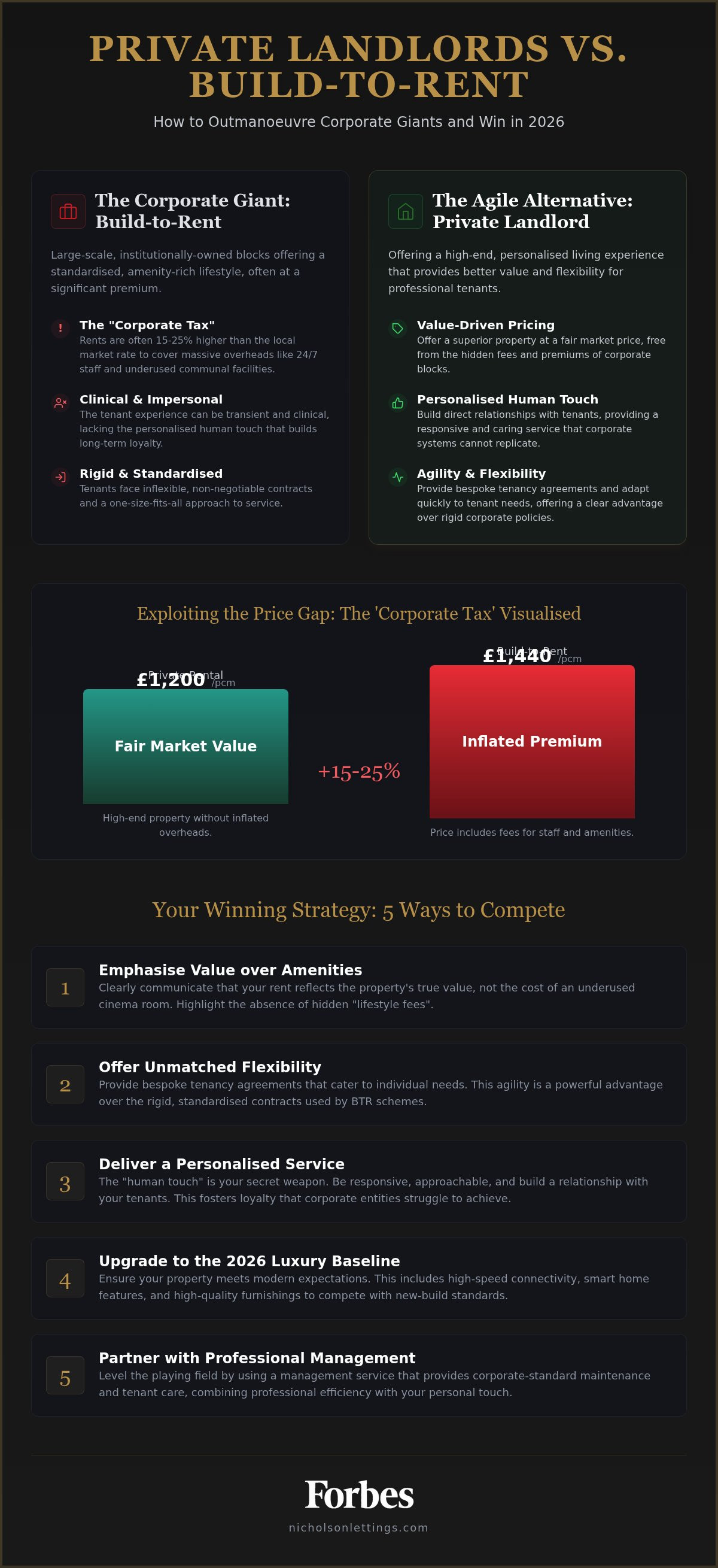
Build to Rent developments aren't just selling floor space; they're selling a brand. Institutional investors have massive overheads, from staffing 24-hour concierges to maintaining sprawling communal lounges. To cover these costs, they often apply a "Corporate Tax" to their rents. This usually results in tenants paying between 15% and 25% above local market rates for a property of similar square footage. For an individual landlord, this price gap is your strongest lever. You can offer a high-end luxury apartment at a price that reflects the property's actual value, rather than the cost of an underused cinema room.
The growth of these schemes has led to a noticeable shift in market supply. Industry experts at Propertymark have highlighted Why Do They Threaten Private Landlords? by illustrating how institutional growth masks the departure of traditional rental stock. However, savvy tenants are now looking closer at the "Total Cost of Renting". They're noticing the hidden service charges or "lifestyle fees" that BTR developments often bake into the monthly rent. When you strip away the corporate padding, the private rental often becomes the more financially sound choice for a professional tenant.
Transparency as a Competitive Advantage
Transparency is a powerful tool when learning how to compete with Build to Rent schemes. Many corporate blocks require tenants to sign rigid, standardised contracts that offer very little room for negotiation. You can win by offering flexible tenancy agreements that cater to professionals with bespoke requirements. In competitive markets like the Liverpool City Region, highlighting the absence of hidden amenity fees makes your property stand out. It's about proving that your rental is the high-end value alternative. Clear communication regarding costs builds trust, which is something a faceless corporate entity often struggles to replicate.
Value-Added Services Without the Corporate Price Tag
You don't need a massive marketing budget to rival the "no deposit" hooks used by BTR blocks. Many private landlords now utilise deposit alternatives to lower the initial move-in barriers for high-quality tenants. This provides the same financial flexibility as a corporate block but within a more personal rental setting. Focus your investment on "luxury where it matters", such as high-spec kitchens and modern bathrooms. These are the spaces tenants use every day, and they carry more weight than a communal gym they might never visit. If you want to refine your property's market position, our team at Nicholson Lettings can help you implement these professional standards whilst protecting your ROI.
Amenities vs. Agility: Where Private Landlords Can Win
Corporate BTR developments often feel like high-end hotels. Whilst this appeals to some, it creates a transient atmosphere that many long-term professional tenants find clinical. Private luxury properties, particularly those in converted heritage buildings or established residential areas, offer something corporate blocks cannot: personality and space. Many BTR units are designed as compact "pods" to maximise density. In contrast, private apartments often provide significantly more square footage for the same price point. This extra room is a massive draw for professionals who now work from home and require a dedicated office space rather than a desk in a communal lounge.
Agility is your greatest weapon. If a tenant wants to hang a picture, paint a feature wall, or move in with a small pet, a corporate block often requires a board-level decision or a rigid policy check. As an individual landlord, you can approve these requests in minutes. This flexibility makes a property feel like a home rather than a temporary residence. Research from Savills on The Corporate Premium: Exploiting the Price Gap suggests that whilst institutional investment is growing, the demand for high-quality, agile private rentals remains robust amongst those who value space over communal cinema rooms.
Personalisation and the "Human Touch"
Tenants today are tired of faceless portals and revolving concierge desks. They want a relationship with someone who understands their needs. This is where a dedicated tenant liaison officer becomes invaluable. Knowing that a real person is looking after the property builds trust and encourages longer tenancies. It's a level of service that corporate entities struggle to replicate at scale. Our look at how dedicated maintenance impacts retention shows that when issues are resolved by a familiar team, tenants are far more likely to renew their agreements. They value the peace of mind that comes from knowing exactly who to call when things go wrong.
Targeting the "Single-Family" and Professional Niche
BTR schemes are frequently high-density environments. This often leads to noise complaints and a "student-adjacent" feel that established professionals want to avoid. You can win by marketing your property as a quiet, exclusive sanctuary. In areas like St Helens or Wigan, the demand for fully furnished luxury apartments is high amongst professionals who want a "plug-and-play" lifestyle without the noise of a 300-unit block. Positioning your property as a peaceful retreat is a key strategy when considering how to compete with Build to Rent schemes. It's about offering an escape from the city centre bustle whilst maintaining the same high standards of interior design and furnishing.
Upgrading Your Property to Compete with 2026 Standards
To succeed in today's rental market, you must meet the new luxury baseline. High-end furniture and modern appliances are no longer optional upgrades; they are the standard requirement for professional tenants. In 2026, renters expect seamless technology integration as part of their tenancy. This includes smart thermostats for efficient climate control, ultra-fast Wi-Fi, and USB-C socket upgrades in bedrooms and living areas. Energy efficiency is equally critical. Improving your EPC rating is a powerful marketing tool that appeals to eco-conscious tenants who want to keep utility bills manageable whilst reducing their carbon footprint.
Avoid the trap of "landlord beige" at all costs. Bold, high-end interior design makes your property stand out instantly in Rightmove listings. Currently, luxury furnished flats in St Helens and Liverpool are significantly outperforming unfurnished stock because they provide an immediate, high-quality lifestyle solution. We advise landlords to invest in "Instagrammable" features like designer lighting or textured feature walls to create a lasting emotional connection with prospective tenants. These visual cues signal excellence and justify your premium rent from the first viewing.
Professional Management: The Ultimate Equaliser
Self-managing is perhaps the biggest risk when considering how to compete with Build to Rent schemes. Corporate blocks win because they offer perceived reliability and safety. To match this, you need a management system that ensures proactive safety compliance, including rigorous gas, electric, and fire safety checks. Choosing expert property management provides that corporate feel of reliability without the cold, clinical distance of a BTR portal. A dedicated team ensures your property never falls behind the "new build" standard. If you want to elevate your portfolio to meet these 2026 expectations, contact Nicholson Lettings to discuss our professional management and maintenance services.
Why Nicholson Lettings is the Landlord’s Secret Weapon Against BTR
Nicholson Lettings acts as the professional equaliser for private landlords. We provide individual property owners with the high-end infrastructure typically reserved for corporate blocks, ensuring you can match the service levels of institutional investors. Our approach is rooted in the Nicholson Group’s unique heritage, combining deep property development expertise with a sophisticated lettings operation. This background means we don't just manage properties; we maintain them to the exacting standards of a luxury new-build developer, such as Pimlico Homes. This is a critical component in understanding how to compete with Build to Rent schemes effectively whilst protecting your long-term ROI.
Our tenant sourcing process is designed to attract the top 1% of the rental market. These are high-earning professionals who prioritise privacy, space, and bespoke finishes over the noisy communal cinemas of a 300-unit block. We focus on finding occupants who value the "human touch" and high-spec interiors. With a dedicated maintenance team at our disposal, we ensure your property never falls behind the standards set by corporate competitors. We treat every apartment in our portfolio with the same "premium care" that institutional landlords apply to their entire developments.
We believe that landlord peace of mind comes from superior tenant satisfaction. Our dedicated tenant liaison officer serves as a single point of contact, building real relationships that corporate portals simply cannot replicate. This proactive communication reduces friction and encourages longer tenancies. Additionally, our deposit-alternative scheme removes the significant upfront cost barrier for renters. This makes your property the most attractive and accessible option on the market, directly rivalling the "no deposit" hooks used by BTR schemes in St Helens, Wigan, and Liverpool.
Maximising Your ROI in the Face of Competition
In a crowded market, visibility is everything. We keep void periods to a minimum through aggressive, high-end marketing that positions your property as an exclusive sanctuary. Managing a portfolio of 250+ luxury properties across the Liverpool City Region gives us an unparalleled data set. We understand exactly what tenants are willing to pay for premium features in 2026. This allows us to price your rental perfectly, balancing high yields with tenant longevity. If you are ready to elevate your portfolio and learn more about how to compete with Build to Rent schemes through professional management, request a professional property management consultation today. Our team is ready to help you outmanoeuvre the corporate blocks and secure your place as a leader in the luxury private rental market.
Securing Your Competitive Edge in the 2026 Rental Market
The rise of institutional landlords doesn't signal the end for the private investor; it simply sets a higher bar for excellence. Success now depends on your ability to offer the same luxury standards as corporate blocks whilst retaining the agility and personal touch they lack. By investing in the right technology, maintaining a high-spec aesthetic, and eliminating hidden fees, you create a compelling alternative for the modern professional. Understanding how to compete with Build to Rent schemes means moving beyond the traditional rental model and embracing a service-first mindset that prioritises tenant experience.
We help you achieve this through our award-winning local expertise and a dedicated in-house maintenance team. Managing 250+ luxury properties across the region, we provide the professional infrastructure you need to thrive in a competitive landscape. Compete with the best—discover our expert property management services. With the right strategy and a proactive partner, your property won't just survive the corporate shift; it will set the new standard for luxury living in the Liverpool City Region.
Frequently Asked Questions
Is Build to Rent a threat to small-scale landlords in Liverpool?
Build to Rent developments are a significant competitive force in Liverpool, particularly in the Baltic Triangle and city centre. These schemes target high-earning professionals, which was once the exclusive domain of private luxury rentals. Whilst they represent a threat to unmanaged or low-quality stock, they also provide a clear benchmark. Small-scale landlords who modernise their properties and offer a more personalised service can successfully navigate how to compete with Build to Rent schemes.
Can I charge the same rent as a Build to Rent scheme?
You should typically aim to price your property slightly below BTR levels whilst maintaining a luxury standard. Corporate blocks often charge a 15% to 25% premium to cover their massive overheads and communal amenities. By positioning your rental as the high-end value alternative, you attract savvy tenants who want luxury interiors without paying for a cinema room they won't use. This approach ensures high yields whilst keeping your property consistently occupied and profitable.
What amenities do tenants value most in 2026?
In 2026, professional tenants prioritise functional luxury over communal gimmicks. Ultra-fast, reliable Wi-Fi and dedicated home office spaces are non-negotiable for the hybrid workforce. Smart home technology, such as intelligent thermostats and integrated USB-C charging points, also ranks highly. Additionally, eco-conscious renters now look for high EPC ratings to manage utility costs. Focus your investment on these internal features rather than trying to replicate the sprawling communal lounges found in massive corporate developments.
How do I make my private rental property feel more professional?
Professionalism starts with your management structure and aesthetic choices. Moving away from "landlord beige" in favour of bold, designer interiors immediately elevates your property's status. Implementing professional property management ensures that maintenance requests are handled with corporate-level speed. Using transparent, flexible tenancy agreements and deposit-alternative schemes also signals that you operate at a high standard. These steps are essential when learning how to compete with Build to Rent schemes effectively in the current market.
Are deposit-alternative schemes safe for landlords?
Deposit-alternative schemes are a highly secure and effective tool for modern landlords. These products, such as those provided by Reposit, offer the same level of protection as a traditional cash deposit whilst lowering the move-in barrier for tenants. They often provide landlords with more comprehensive cover for damages or rent arrears than the standard five-week cap. This flexibility makes your property more competitive and attracts high-quality professionals who prefer to keep their capital fluid.
Why are professional tenants moving away from corporate BTR blocks?
Many tenants find the high-density nature of corporate blocks leads to a transient, student-adjacent atmosphere. The clinical design and lack of character in BTR units often feel less like a home and more like a hotel. Additionally, the "corporate premium" on rent eventually drives long-term tenants toward private rentals that offer more square footage and personality. Private properties provide a quieter, more exclusive sanctuary that better suits established professionals seeking long-term stability.
What is the "corporate premium" in the UK rental market?
The "corporate premium" is the additional 15% to 25% rent that BTR developments charge above local market rates for comparable space. This extra cost funds the on-site staff, gyms, and communal facilities that institutional investors use to market their "lifestyle" packages. Savvy landlords exploit this gap by offering the same high-quality internal finishes without the inflated price tag. This allows you to secure professional tenants who value luxury but reject the unnecessary corporate overhead costs.
How does professional property management improve tenant retention?
Professional management replaces the unpredictability of a private landlord with a reliable, service-led infrastructure. Tenants are far more likely to renew their agreements when maintenance issues are resolved within 24 hours by a dedicated team. Having a tenant liaison officer provides a consistent, human point of contact that corporate portals cannot replicate. This proactive care builds trust and loyalty, which are the most effective ways to reduce void periods and maintain high rental yields.