Council Tax Bands in St Helens: How to Check Yours in 2026

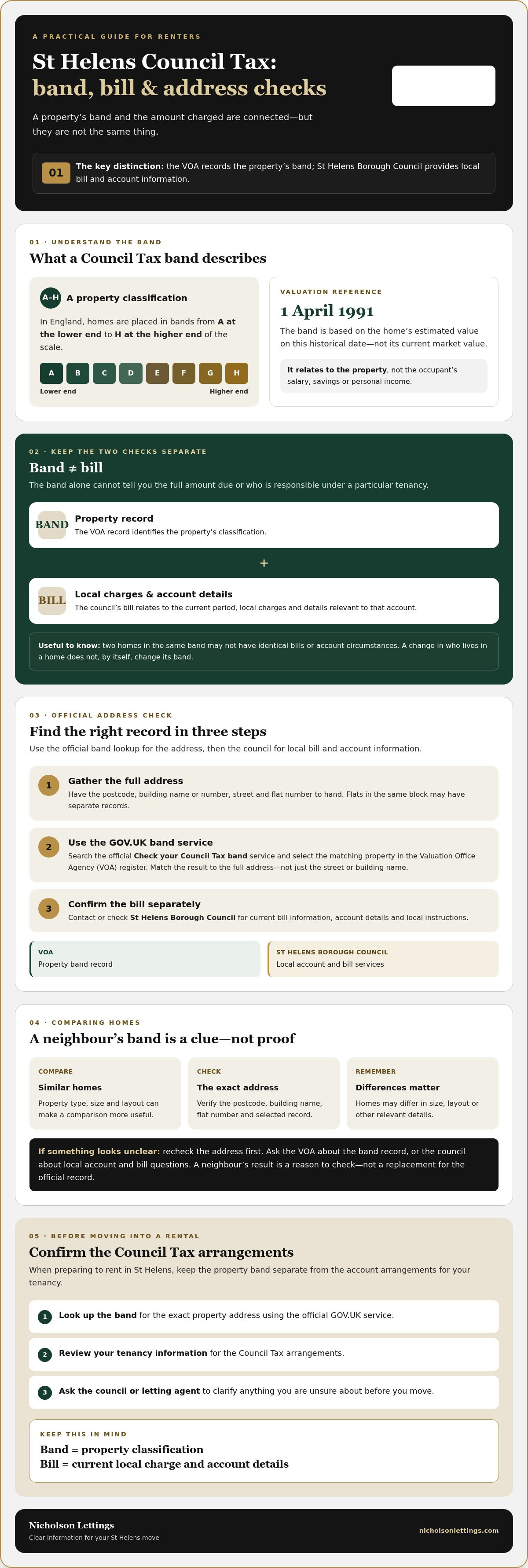
Could a St Helens property’s Council Tax bill change while its band stays the same? Yes. If you’re checking council tax bands St Helens before a move, first separate the property’s band from the amount charged for the current year. They’re connected, but they aren’t the same thing.
It’s easy to feel unsure when an advert, a neighbour’s bill and an official record appear to show different information. In England, a property’s band is based on its estimated value on 1 April 1991 and is set by the Valuation Office Agency (VOA). The council works out the bill separately, using the local charges and relevant account details.
This guide explains how to check a St Helens address using the official GOV.UK band service, what the band does and doesn’t tell you, and why a neighbour’s property is a comparison, not proof that a band is wrong. If you’re preparing to rent, you’ll also find out what to check with the council or letting agent about the account and tenancy arrangements before you move in.
Table of Contents
What do Council Tax bands in St Helens mean?
A Council Tax band places a home within England’s banding system. It reflects the property’s estimated value on 1 April 1991, not its current market value or the income of the person living there. So, when checking council tax bands St Helens, you’re checking a property classification, not a personal assessment of you as a tenant.
The band is one part of understanding Council Tax. It doesn’t tell you the full amount due or confirm who is responsible for an account under a particular tenancy. For a general background to what Council Tax bands mean, see this overview of the system. To check the band recorded for a specific St Helens address, use the official property lookup described below.
How are Council Tax bands in England arranged?
In England, residential properties are placed in bands from A to H, with A at the lower end of the scale and H at the higher end. The band reflects the property’s estimated value on the historical valuation date of 1 April 1991. It relates to the home, not the occupant’s salary, savings or other personal income.
This distinction is useful when you’re renting. A change in who lives in a property doesn’t, by itself, mean the property has moved into a different band. The band is associated with the address, while account details and the bill relate to the current Council Tax arrangements.
Does a Council Tax band tell you the bill amount?
No. The band is a classification; the bill is the amount charged for a particular period. St Helens Borough Council provides local charge and account information, so check its current guidance for the details that apply to the property and account you’re asking about.
Two homes in the same band may not have identical bills or account circumstances. The bill can reflect local charges and details relevant to that account. The band alone won’t confirm whether support or another adjustment applies, or who is responsible under a particular tenancy.
If you’re preparing to move, make two separate checks: look up the property’s band, then confirm the bill and account information with St Helens Borough Council. This helps you avoid relying on an advert, an old bill or a neighbour’s circumstances to make assumptions about your own situation.
How to check a property’s Council Tax band in St Helens
For a reliable result, check the official property record rather than relying on an advert, a previous tenant’s paperwork or a third-party checker. The GOV.UK Check your Council Tax band service searches the Valuation Office Agency (VOA) register, which records a property’s band. St Helens Borough Council is the local source for Council Tax account and bill services.
Which official sources should St Helens residents use?
Use the VOA lookup to find the band recorded for an address. Use St Helens Borough Council to check local account information, bills and borough-specific instructions. These are separate checks: the VOA record identifies the property band, while the council handles local Council Tax services. A private checker may help you find information, but it isn’t the official decision-maker.
Follow these steps:
1. Identify the full address. Have the postcode, building name or number, street and flat number to hand. For flats, check the exact unit, since homes in the same block may have separate records.
2. Search the official band lookup. Enter the address in the GOV.UK service and select the matching property in the VOA register. Check the result against the full address, not just the street or building name.
3. Confirm what you need to know. Use the band result for the property classification. For the current bill, account details or local instructions, check with St Helens Borough Council.
What if the address or band result looks unclear?
Pause before drawing conclusions. Check the spelling, postcode, flat number and selected property. A small difference in a building name or unit number can lead you to a different record. If the address is missing from the VOA lookup, or the result appears to conflict with reliable information about that exact home, contact the relevant official service: the VOA for the band record, or the council for local account and bill questions.
A neighbour’s band can prompt a closer look, but it doesn’t prove your property’s band is wrong. The homes may differ in size, layout or other relevant details. Compare like with like, and treat a neighbour’s result as a reason to check the official record, not a replacement for it. Separating confirmed information from assumptions can make planning a move less stressful.
If you’re also looking for a managed furnished home in St Helens, Nicholson Lettings offers furnished rental homes.
What can neighbouring Council Tax bands tell you?
Nearby property records can help you decide whether a band difference is worth looking into. But the closest home isn’t always the fairest comparison. When checking council tax bands St Helens, use neighbouring records as a starting point, then check whether the homes are genuinely alike and confirm the details through official sources.
Which neighbouring homes make a useful comparison?
Look for homes with similar characteristics, not simply an address on the same street. Property type, size and layout all affect how useful a comparison may be. Relevant historical context can matter too, since bands reflect estimated property values at a past valuation date. Don’t assume homes with similar-looking fronts or the same postcode are equivalent.
Use questions like these to keep your comparison consistent:
Use available records rather than guessing about a property’s features or history. If key details aren’t clear, treat the comparison cautiously. A nearby home may have a different band for reasons that aren’t obvious from the street.
When should you ask about a possible band challenge?
If you find a specific reason to question the band after checking the property record and comparing genuinely similar homes, read the VOA’s official guidance on challenging a Council Tax band. Follow its instructions before deciding what to do next. St Helens Borough Council can help with local account or bill questions, but the VOA is the relevant source for the property band record.
A neighbour comparison is a prompt for research, not proof that a Council Tax band is wrong. A nearby home in a different band doesn’t establish an error, and a comparison can’t guarantee that a challenge will change the band. Check the facts first and use official guidance to understand the appropriate next step.
How is a St Helens Council Tax band different from your bill?
A band identifies a property’s place in the Council Tax system. It doesn’t show the exact amount a household will be billed. St Helens Borough Council issues local bills and manages Council Tax accounts, so use the council’s official services to check current bill information, account details and any support that may apply.
This distinction matters if you’re renting. A band lookup can tell you the classification recorded for the property, but it can’t confirm the amount on a particular account, whether a reduction applies or who is responsible under your tenancy. Those questions depend on information that a property band checker doesn’t hold. Check with the council for reliable details instead of trying to work them out from the band alone.
Where can you check a bill or ask about support?
Use St Helens Borough Council’s Council Tax services for local account information and bill queries. If you want to find out whether a reduction or other support route may be relevant, check the council’s current guidance and follow its instructions. Confirm eligibility and account details directly with the council. The VOA band record can’t tell you whether support applies to your household.
If your question concerns the property’s recorded band, use the Valuation Office Agency service. If it concerns a bill, payment record, account or support, contact St Helens Borough Council. Keeping those routes separate helps you get an answer from the right place, without confusing a property record with a household account.
What details should you have ready?
Preparing a few details can make it easier to explain your question and help the council identify the right account. Before you contact them, gather:
The full property address, including the flat number or building name where relevant.
Your Council Tax account reference, if you’re asking about an existing account.
The bill or official correspondence relating to your query, if you have it.
A clear description of the issue, such as a question about the bill, account details or support.
If you’re not yet responsible for an account or don’t have a bill, explain that when you contact the council and ask what information it needs. For tenancy-specific arrangements, ask your letting agent to clarify what the tenancy documents say, while checking account and bill matters with the council. This can be especially useful before moving, when paperwork may still be coming together.
Checking council tax bands St Helens is a useful first step, but it’s only one part of planning a move. If you’re also looking for a managed furnished home in the area, Nicholson Lettings has furnished homes in St Helens.
Renting in St Helens? Confirm Council Tax arrangements before you move
Moving home involves plenty of details, and Council Tax can be easy to overlook while you’re arranging everything else. Before agreeing a tenancy, check the exact address and its band, read the tenancy information and ask about anything that remains unclear. Don’t assume who is responsible for Council Tax based on the property type or what happened in your previous home.
What should you ask before agreeing a tenancy?
Ask how Council Tax arrangements are described for the specific property and tenancy. Clarify which questions should go to St Helens Borough Council and which concern the tenancy documents or arrangements. The council is the place to confirm the property band and account information; your letting agent can explain what the tenancy paperwork says. Neither replaces the other.
Before you commit, work through these checks:
Confirm the full address, including the flat or unit number, and check the recorded band using the official lookup.
Read the tenancy information for any reference to Council Tax arrangements.
Ask the council about local account or bill questions, and ask your letting agent to clarify tenancy-specific wording.
Keep a note of unanswered questions and seek clarification before relying on an assumption.
If the home is managed, you may also want to understand how the agent communicates with tenants and handles property-related queries. Nicholson Lettings manages furnished rental homes in St Helens and across the Liverpool City Region. Its guide to property management in St Helens offers further context on managed tenancies. For questions about your Council Tax account or band, check with the relevant official service.
How can landlords and renters keep information clear?
Keep a copy of the signed tenancy documents and any relevant Council Tax correspondence somewhere you can find them. Landlords and renters can help avoid confusion by referring to the same written information and raising inconsistencies promptly. Clear rental administration can support a smoother handover. For related guidance, see this landlord’s guide to expert property management.
Checking council tax bands St Helens is one practical part of preparing for a move, but the band alone won’t settle tenancy or account questions. Confirm each detail with the right source, and keep the answers with your moving paperwork.
Nicholson Lettings also offers furnished homes in St Helens, with tenant support for managed tenancies. More information about Nicholson Lettings and its tenant support is available online.
Take these checks with you into your next move
Checking council tax bands St Helens starts with the official Valuation Office Agency record for the exact address. Remember that the band is a property classification, not the amount on a household’s bill. For bill and account questions, use St Helens Borough Council’s services.
Neighbouring homes can offer useful context, but a different band nearby doesn’t prove that a property’s band is wrong. Before you move, read the tenancy information and ask your letting agent to clarify any arrangements you’re unsure about. Confirm account questions with the council, and keep relevant documents to hand.
If you’re searching for a furnished home in St Helens, Nicholson Lettings manages over 250 properties across the Liverpool City Region, including St Helens. Tenants can access a dedicated Tenant Liaison Officer for support with tenancy-related matters. Explore furnished homes and tenant support from Nicholson Lettings.
Frequently Asked Questions
How do I check the Council Tax band for a property in St Helens?
Use the GOV.UK “Check your Council Tax band” service, managed by the Valuation Office Agency (VOA), and search using the full property address. Check the selected record carefully, especially if it’s a flat or shares a building name with other homes. This is the official route for checking council tax bands St Helens. For bill or account queries, contact St Helens Borough Council.
What are the Council Tax bands in England?
In England, homes are assigned to one of eight Council Tax bands, from A to H. The band relates to the property’s estimated value at the relevant historical valuation date, not the income of the person living there. Band A is at the lower end of the scale and Band H at the higher end. Check the VOA record to confirm a specific property’s band.
Are Council Tax bands in St Helens based on current property values?
No. In England, Council Tax bands are based on the property’s estimated value on 1 April 1991, not its current market value. Present-day property estimates don’t by themselves determine the band. To check what’s recorded for a St Helens address, use the VOA’s official band lookup. Contact the VOA if you need guidance about the property’s band record.
Can my Council Tax band be different from my neighbour’s in St Helens?
Yes. Nearby homes can have different bands, even if they’re on the same street or share a postcode. Differences in property type, size, layout or relevant historical context may affect whether two homes are genuinely comparable. Check both addresses in the VOA register before drawing conclusions. A neighbour’s band can prompt further research, but it doesn’t prove that your property’s band is incorrect.
Does my Council Tax band tell me exactly how much I will pay?
No. The band is a property classification, not the exact amount due on a household’s bill. St Helens Borough Council issues local bills and manages account information, so check its current services for details relevant to your account. The VOA band lookup can confirm the recorded band, but it can’t confirm a personal bill or whether support applies to your circumstances.
Can tenants check a Council Tax band before moving into a St Helens rental?
Yes. You can search the VOA register before moving, using the property’s full address and checking the correct flat or unit. Read the tenancy information too, then ask your letting agent to clarify anything about the tenancy arrangements that remains unclear. Contact St Helens Borough Council about local bill or account questions. Don’t assume who is responsible for Council Tax without checking the relevant arrangements.
What should I do if a property’s Council Tax band seems wrong?
First, make sure you’ve selected the correct address in the VOA register. If a comparison with similar properties gives you a specific reason to question the band, read the VOA’s official guidance on challenging a band and follow its instructions. A neighbour’s different band isn’t proof of an error, and a challenge doesn’t guarantee a change. Ask the VOA about the band record; contact the council for bill or account queries.